
Why API Testing Is Becoming More Important Than UI Testing in Modern Airline Platforms
Why API Testing Is Becoming More Important Than UI Testing in Modern Airline Platforms
Suresh Kuruva, SDET-II
Read: 5 min
Introduction
Airline platforms used to expose much of their complexity through user interfaces. A booking engine screen, a seat map, a payment page, or a check-in flow gave quality teams a visible place to validate business behaviour. If the screen worked, there was at least some confidence that the underlying transaction was working too.
That model no longer reflects how modern airline technology operates.
Today, the most important airline transactions happen through interconnected APIs long before a traveller sees the result on a screen. Flight shopping, availability checks, offer pricing, seat selection, baggage, upgrades, loyalty redemption, payment authorization, disruption servicing, and partner distribution all depend on services exchanging data in real time. The UI is often just one channel sitting on top of a much larger API ecosystem.
This shift is changing how airline technology teams need to think about quality. UI testing remains important for validating customer experience, usability, and complete journeys. But API-first testing is becoming the foundation for release readiness because it validates the logic, data, contracts, and integrations that modern airline platforms actually depend on.

Airline Business Logic Has Moved Below the Interface
In a traditional application stack, UI testing could catch a meaningful share of functional defects because business logic and presentation were closely connected. In modern airline platforms, that connection is far more distributed.
A single flight shopping request may touch inventory, pricing, offer management, tax calculation, loyalty eligibility, personalization, payment rules, partner content, and caching layers. Seat selection may involve aircraft configuration, fare family rules, passenger status, paid seat pricing, accessibility rules, and servicing constraints. Ancillary purchases may depend on eligibility logic, dynamic pricing, fulfilment, revenue accounting, and post-booking modification rules.
The traveller may only see a fare card, a seat map, or a checkout confirmation. But the quality risk lives across the services behind those screens.
This is why API response validation has become so important. Teams need to know whether APIs are returning the right data, in the right format, with the right business rules applied, under the right conditions. Waiting until the UI exposes a broken scenario often means the defect has already travelled too far downstream.
API Testing Finds Defects Earlier and Closer to the Source
One of the strongest arguments for API-first testing is defect localization. When a UI test fails, the root cause can sit almost anywhere: frontend rendering, backend logic, service orchestration, data quality, authentication, third-party latency, or an upstream contract change. The test may reveal a symptom, but not always the source.
API testing narrows that gap.
By validating services directly, quality engineering teams can identify whether the issue sits in pricing logic, availability response, customer profile data, loyalty calculation, payment handling, or partner integration. This is especially valuable in airline environments where release windows are tight, and multiple teams may own different parts of the journey.
For example, if an ancillary offer appears incorrectly in the booking path, an API-level test can help determine whether the problem is caused by eligibility rules, offer construction, content mapping, or frontend display. That distinction matters because each failure path belongs to a different team, backlog, and release decision.
API testing supports shift-left testing because defects are caught earlier in the development lifecycle. Teams can validate service behaviour before the full UI is ready, before partner channels are fully integrated, and before end-to-end journeys are stable enough for broad regression testing.
UI Regression Alone Cannot Scale With Airline Platform Complexity
Airline platforms have a large regression surface. Routes, fare types, passenger categories, loyalty tiers, payment methods, currencies, ancillaries, distribution channels, servicing rules, and disruption scenarios create thousands of possible combinations.
Trying to validate all of this through UI automation becomes slow, brittle, and expensive. UI tests are valuable, but they are also more exposed to layout changes, selector changes, browser differences, environment instability, and timing issues. When teams over-rely on UI automation, regression suites can become difficult to maintain and slow to execute.
API automation helps reduce regression effort by moving a large portion of validation closer to the service layer. Instead of testing every pricing, seat, baggage, or loyalty rule through the interface, teams can validate many scenarios through stable API calls and reserve UI automation for the workflows where user experience truly matters.
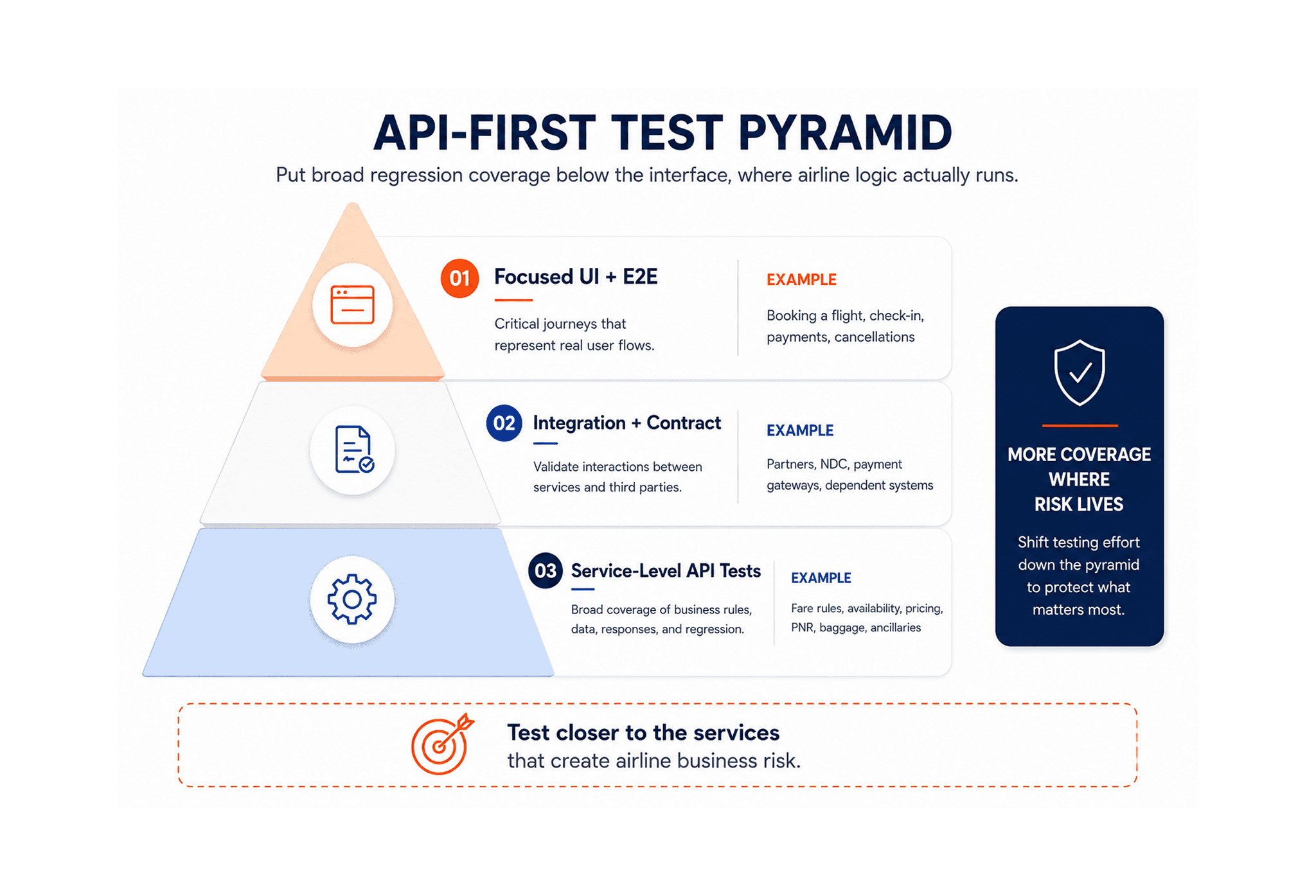
A healthier airline test strategy typically uses:
API tests for business rules, response validation, integration behaviour, data consistency, and service contracts.
UI tests for critical customer journeys, usability-sensitive flows, rendering behaviour, and channel-specific experience.
End-to-end tests for high-risk journeys such as booking, payment, servicing, refund, and disruption management.
This approach improves test coverage optimization. It does not remove UI testing; it uses UI testing where it has the most value.
NDC Ecosystems Make Contract Testing Essential
The rise of NDC and modern airline retailing has made API quality even more business-critical. Airline offers now move through a network of direct channels, travel sellers, aggregators, servicing platforms, payment providers, loyalty systems, and downstream operational systems. A small mismatch in schema, field interpretation, offer rules, or version handling can create commercial and operational friction.
In an NDC ecosystem, contract testing becomes essential because each participant depends on agreed API behaviour. If an airline changes an offer response structure, an ancillary attribute, a seat availability field, or an order servicing flow without proper validation, downstream partners may fail silently or produce inconsistent traveler experiences.
Contract testing helps teams validate that services continue to meet agreed expectations as APIs evolve. This is particularly important when airlines are balancing legacy PSS dependencies with modern Offer-Order architecture, channel expansion, and partner onboarding.
For airline technology leaders, the question is not only, “Does the API work?” It is also, “Does this API behave consistently for every consuming channel, partner, and journey we are responsible for?”
Service-Level Validation Protects the Customer Journey
Modern airline customer experience depends on service-level reliability. A traveller does not care whether a failed seat purchase came from a seat service, payment gateway, order management platform, or data mapping issue. They experience one broken journey.
Service-level testing helps prevent those failures by validating each service in context. It checks whether APIs return accurate responses, handle exceptions correctly, preserve data consistency, and perform within expected thresholds. It also helps teams understand how services behave when upstream systems are delayed, unavailable, or returning partial data.
This matters in several common airline scenarios:
Flight shopping: Are price, availability, fare rules, and offer content consistent across channels?
Seat selection: Are paid seats, blocked seats, elite benefits, and aircraft layouts handled correctly?
Ancillary purchase: Are baggage, meals, upgrades, and bundles priced and fulfilled according to eligibility rules?
Order servicing: Are changes, cancellations, refunds, and exchanges reflected accurately across systems?
Disruption handling: Are rebooking options, traveler notifications, and operational updates synchronized?
API testing gives teams a practical way to validate these conditions without waiting for every scenario to be executed manually through the UI.
Test Data Management Becomes a Quality Engineering Capability
API-first testing is only as strong as the data behind it. Airline test scenarios depend on highly variable data: routes, schedules, inventory, fare classes, aircraft types, passenger types, loyalty profiles, disruption events, order states, currencies, and partner configurations.
Without reliable test data management, API automation can become unstable. Tests fail because inventory changes, fare rules expire, seats are unavailable, profiles are incomplete, or orders are no longer in the right state.
Quality engineering teams need governed test data strategies that support repeatable validation across services. This may include synthetic data, controlled test markets, mock services, service virtualization, seeded passenger profiles, reusable order states, and automated data refreshes.
For API-first airline platforms, test data management is not a support task. It is part of the quality architecture.
Continuous Testing Strengthens Release Readiness
Airline platforms are under constant pressure to release faster while protecting revenue, operations, and customer trust. CI/CD pipelines help teams move quickly, but speed without validation increases risk.
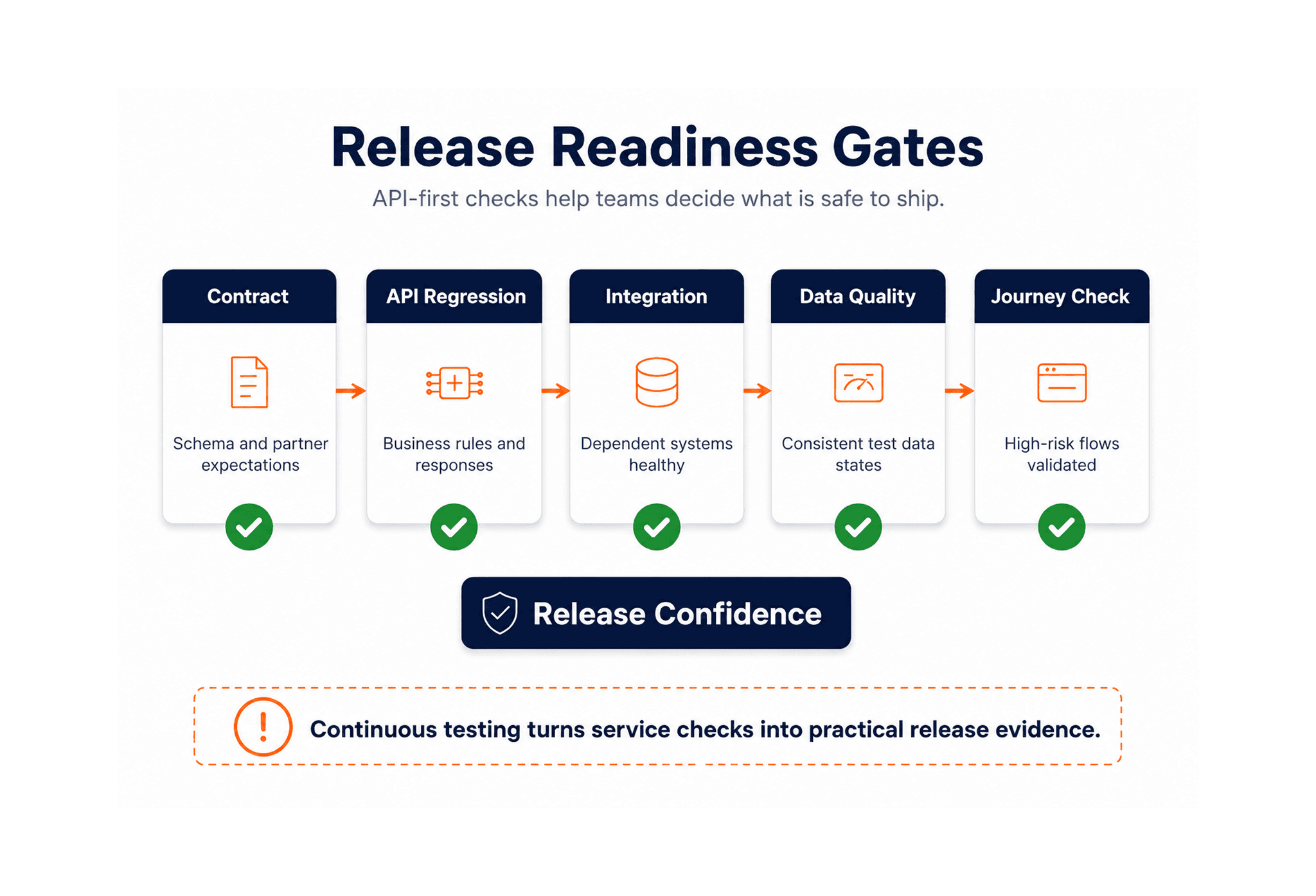
API testing fits naturally into continuous testing because service-level checks can run earlier, faster, and more frequently than full UI regression suites. Teams can use API automation as part of build validation, deployment gates, environment checks, and release readiness dashboards.
In more mature environments, a real time analytics platform can help quality and release teams connect API regression results, contract validation, integration health, and production risk signals into one release-readiness view.
A mature API testing strategy helps answer practical release questions:
Which services changed, and which business journeys are affected?
Have the relevant API contracts been validated?
Are critical responses still consistent across channels?
Did integration tests pass against dependent systems?
Is regression coverage aligned to the actual risk of the release?
Are failures blocking, informational, or acceptable with mitigation?
This is where risk-based testing becomes important. Not every release needs the same level of validation. A pricing engine change, NDC schema update, payment integration change, or loyalty rule modification should trigger deeper API and integration coverage than a low-risk content update.
UI Testing Still Matters, But Its Role Is Changing
API testing becoming more important does not make UI testing obsolete. The airline customer experience still depends on clear interfaces, fast pages, intuitive flows, accessible design, accurate messaging, and consistent behaviour across devices.
What is changing is the role of UI testing.
Instead of carrying the full burden of functional validation, UI testing should confirm that the customer-facing experience works as intended on top of already validated services. It should focus on the journeys where interface behaviour, visual state, customer decision-making, and usability affect business outcomes.
In other words, API testing creates confidence in the engine. UI testing confirms the traveler can use the vehicle.
Building an API-First Testing Strategy for Airline Platforms
For airline technology teams, API-first testing is not simply a tooling decision. It requires a quality engineering model that connects architecture, automation, data, contracts, environments, and release governance.
A practical strategy should include service-level test coverage for core airline APIs, contract testing for partner and channel integrations, automated regression suites for high-risk business rules, integration testing across dependent systems, and end-to-end validation for revenue-critical journeys.
It should also include clear ownership. Product teams, engineering teams, QA leaders, platform teams, and integration owners need shared standards for API behaviour, test data, automation patterns, and release gates. Without that operating model, API testing can become fragmented across teams and lose strategic value.
The goal is not to test more for the sake of testing more. The goal is to test closer to where risk is created.
Airline Business Logic Has Moved Below the Interface
In a traditional application stack, UI testing could catch a meaningful share of functional defects because business logic and presentation were closely connected. In modern airline platforms, that connection is far more distributed.
A single flight shopping request may touch inventory, pricing, offer management, tax calculation, loyalty eligibility, personalization, payment rules, partner content, and caching layers. Seat selection may involve aircraft configuration, fare family rules, passenger status, paid seat pricing, accessibility rules, and servicing constraints. Ancillary purchases may depend on eligibility logic, dynamic pricing, fulfilment, revenue accounting, and post-booking modification rules.
The traveller may only see a fare card, a seat map, or a checkout confirmation. But the quality risk lives across the services behind those screens.
This is why API response validation has become so important. Teams need to know whether APIs are returning the right data, in the right format, with the right business rules applied, under the right conditions. Waiting until the UI exposes a broken scenario often means the defect has already travelled too far downstream.
API Testing Finds Defects Earlier and Closer to the Source
One of the strongest arguments for API-first testing is defect localization. When a UI test fails, the root cause can sit almost anywhere: frontend rendering, backend logic, service orchestration, data quality, authentication, third-party latency, or an upstream contract change. The test may reveal a symptom, but not always the source.
API testing narrows that gap.
By validating services directly, quality engineering teams can identify whether the issue sits in pricing logic, availability response, customer profile data, loyalty calculation, payment handling, or partner integration. This is especially valuable in airline environments where release windows are tight, and multiple teams may own different parts of the journey.
For example, if an ancillary offer appears incorrectly in the booking path, an API-level test can help determine whether the problem is caused by eligibility rules, offer construction, content mapping, or frontend display. That distinction matters because each failure path belongs to a different team, backlog, and release decision.
API testing supports shift-left testing because defects are caught earlier in the development lifecycle. Teams can validate service behaviour before the full UI is ready, before partner channels are fully integrated, and before end-to-end journeys are stable enough for broad regression testing.
UI Regression Alone Cannot Scale With Airline Platform Complexity
Airline platforms have a large regression surface. Routes, fare types, passenger categories, loyalty tiers, payment methods, currencies, ancillaries, distribution channels, servicing rules, and disruption scenarios create thousands of possible combinations.
Trying to validate all of this through UI automation becomes slow, brittle, and expensive. UI tests are valuable, but they are also more exposed to layout changes, selector changes, browser differences, environment instability, and timing issues. When teams over-rely on UI automation, regression suites can become difficult to maintain and slow to execute.
API automation helps reduce regression effort by moving a large portion of validation closer to the service layer. Instead of testing every pricing, seat, baggage, or loyalty rule through the interface, teams can validate many scenarios through stable API calls and reserve UI automation for the workflows where user experience truly matters.
A healthier airline test strategy typically uses:
API tests for business rules, response validation, integration behaviour, data consistency, and service contracts.
UI tests for critical customer journeys, usability-sensitive flows, rendering behaviour, and channel-specific experience.
End-to-end tests for high-risk journeys such as booking, payment, servicing, refund, and disruption management.
This approach improves test coverage optimization. It does not remove UI testing; it uses UI testing where it has the most value.
NDC Ecosystems Make Contract Testing Essential
The rise of NDC and modern airline retailing has made API quality even more business-critical. Airline offers now move through a network of direct channels, travel sellers, aggregators, servicing platforms, payment providers, loyalty systems, and downstream operational systems. A small mismatch in schema, field interpretation, offer rules, or version handling can create commercial and operational friction.
In an NDC ecosystem, contract testing becomes essential because each participant depends on agreed API behaviour. If an airline changes an offer response structure, an ancillary attribute, a seat availability field, or an order servicing flow without proper validation, downstream partners may fail silently or produce inconsistent traveler experiences.
Contract testing helps teams validate that services continue to meet agreed expectations as APIs evolve. This is particularly important when airlines are balancing legacy PSS dependencies with modern Offer-Order architecture, channel expansion, and partner onboarding.
For airline technology leaders, the question is not only, “Does the API work?” It is also, “Does this API behave consistently for every consuming channel, partner, and journey we are responsible for?”
Service-Level Validation Protects the Customer Journey
Modern airline customer experience depends on service-level reliability. A traveller does not care whether a failed seat purchase came from a seat service, payment gateway, order management platform, or data mapping issue. They experience one broken journey.
Service-level testing helps prevent those failures by validating each service in context. It checks whether APIs return accurate responses, handle exceptions correctly, preserve data consistency, and perform within expected thresholds. It also helps teams understand how services behave when upstream systems are delayed, unavailable, or returning partial data.
This matters in several common airline scenarios:
Flight shopping: Are price, availability, fare rules, and offer content consistent across channels?
Seat selection: Are paid seats, blocked seats, elite benefits, and aircraft layouts handled correctly?
Ancillary purchase: Are baggage, meals, upgrades, and bundles priced and fulfilled according to eligibility rules?
Order servicing: Are changes, cancellations, refunds, and exchanges reflected accurately across systems?
Disruption handling: Are rebooking options, traveler notifications, and operational updates synchronized?
API testing gives teams a practical way to validate these conditions without waiting for every scenario to be executed manually through the UI.
Test Data Management Becomes a Quality Engineering Capability
API-first testing is only as strong as the data behind it. Airline test scenarios depend on highly variable data: routes, schedules, inventory, fare classes, aircraft types, passenger types, loyalty profiles, disruption events, order states, currencies, and partner configurations.
Without reliable test data management, API automation can become unstable. Tests fail because inventory changes, fare rules expire, seats are unavailable, profiles are incomplete, or orders are no longer in the right state.
Quality engineering teams need governed test data strategies that support repeatable validation across services. This may include synthetic data, controlled test markets, mock services, service virtualization, seeded passenger profiles, reusable order states, and automated data refreshes.
For API-first airline platforms, test data management is not a support task. It is part of the quality architecture.
Continuous Testing Strengthens Release Readiness
Airline platforms are under constant pressure to release faster while protecting revenue, operations, and customer trust. CI/CD pipelines help teams move quickly, but speed without validation increases risk.
API testing fits naturally into continuous testing because service-level checks can run earlier, faster, and more frequently than full UI regression suites. Teams can use API automation as part of build validation, deployment gates, environment checks, and release readiness dashboards.
In more mature environments, a real time analytics platform can help quality and release teams connect API regression results, contract validation, integration health, and production risk signals into one release-readiness view.
A mature API testing strategy helps answer practical release questions:
Which services changed, and which business journeys are affected?
Have the relevant API contracts been validated?
Are critical responses still consistent across channels?
Did integration tests pass against dependent systems?
Is regression coverage aligned to the actual risk of the release?
Are failures blocking, informational, or acceptable with mitigation?
This is where risk-based testing becomes important. Not every release needs the same level of validation. A pricing engine change, NDC schema update, payment integration change, or loyalty rule modification should trigger deeper API and integration coverage than a low-risk content update.
UI Testing Still Matters, But Its Role Is Changing
API testing becoming more important does not make UI testing obsolete. The airline customer experience still depends on clear interfaces, fast pages, intuitive flows, accessible design, accurate messaging, and consistent behaviour across devices.
What is changing is the role of UI testing.
Instead of carrying the full burden of functional validation, UI testing should confirm that the customer-facing experience works as intended on top of already validated services. It should focus on the journeys where interface behaviour, visual state, customer decision-making, and usability affect business outcomes.
In other words, API testing creates confidence in the engine. UI testing confirms the traveler can use the vehicle.
Building an API-First Testing Strategy for Airline Platforms
For airline technology teams, API-first testing is not simply a tooling decision. It requires a quality engineering model that connects architecture, automation, data, contracts, environments, and release governance.
A practical strategy should include service-level test coverage for core airline APIs, contract testing for partner and channel integrations, automated regression suites for high-risk business rules, integration testing across dependent systems, and end-to-end validation for revenue-critical journeys.
It should also include clear ownership. Product teams, engineering teams, QA leaders, platform teams, and integration owners need shared standards for API behaviour, test data, automation patterns, and release gates. Without that operating model, API testing can become fragmented across teams and lose strategic value.
The goal is not to test more for the sake of testing more. The goal is to test closer to where risk is created.

Fig: API vs UI Testing Comparison
Conclusion
Airline digital transformation has moved critical business logic away from the screen and into APIs, services, data flows, and partner ecosystems. That shift changes the center of gravity for quality engineering.
UI testing remains necessary, especially for customer-facing experience. But it cannot carry the full weight of modern airline validation. API-first testing gives teams faster defect detection, stronger regression coverage, better integration confidence, and clearer release readiness across complex airline platforms.
For airlines pursuing cloud native application modernization around NDC, microservices, and continuous delivery, API testing is no longer a technical preference. It is becoming the quality foundation for reliable retailing, resilient operations, and better traveler experiences.
Join our newsletter.
Smart reads, bold ideas and what’s next sent to you.
Resources
Join our newsletter.
Smart reads, bold ideas and what’s next sent to you.
Resources
Join our newsletter.
Smart reads, bold ideas and what’s next sent to you.
Resources