Chethan S
Introduction
The aviation industry is going through a quiet but important shift.
Passenger expectations continue to rise. Operations are becoming more complex. At the same time, airlines and airports are under constant pressure to improve margins, reliability, and speed. Many of the systems in place today were built for a very different era, one where change was slower and scale was more predictable.
To keep up, airlines need more than incremental upgrades. They need a different way of thinking about how systems are built and how decisions are made.
At Zapcom, we see two changes shaping the next phase of aviation transformation.
De-coupled NDC architectures that give airlines real control over retail innovation
AI-driven airport operations that bring clarity and speed to complex planning decisions
Together, these shifts help airlines move faster while staying stable.
2. AI-Optimized Gate Assignment: Solving the Airport Operations Puzzle
While airlines modernize distribution and retailing, airport operations teams face a different but equally complex challenge. Gate assignment remains one of the hardest problems to solve at scale.
Gate planning sits at the intersection of aircraft constraints, passenger connections, crew availability, and constant disruption. For decades, this has been handled through manual planning supported by experience and spreadsheets. That approach no longer holds up under today’s traffic volumes and volatility.
The Problem
Manual gate assignment struggles to balance competing priorities:
Aircraft types and turnaround requirements
Passenger walking distances and connection windows
Peak-hour congestion and gate availability
Weather events, delays, and last-minute schedule changes.
When disruptions occur, planners are forced into reactive mode. Passenger misconnects increase. Delays propagate across the network. Coordination effort spikes as teams scramble to adjust plans in real time. The challenge is not just planning gates faster. It is planning them smarter and continuously.
The Solution: AI-Driven Gate Assignment and Optimization
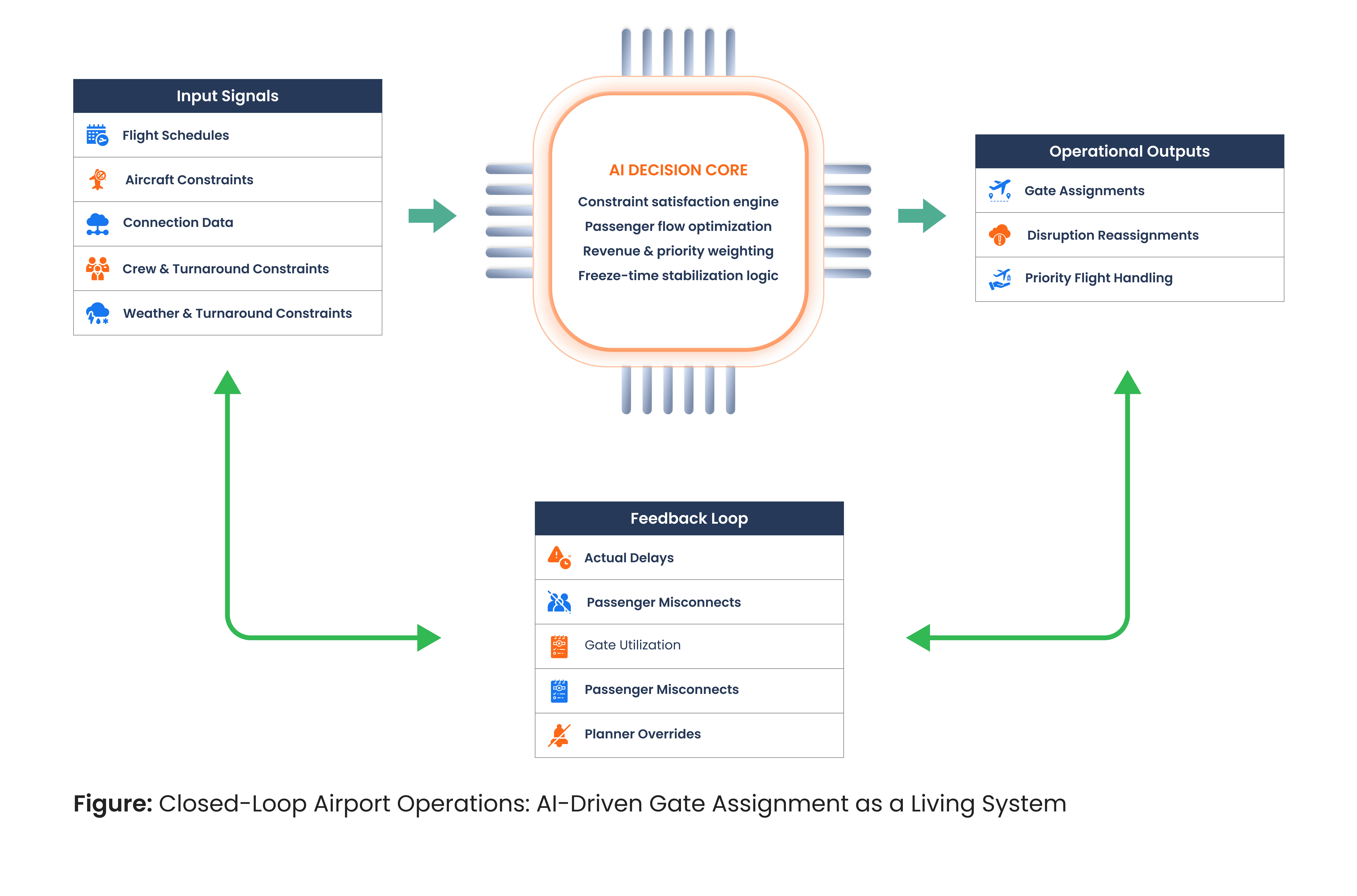
AI changes gate assignment from a static planning task into a dynamic, adaptive system. Zapcom’s AI-powered gate assignment model evaluates flight schedules, passenger flow, and operational constraints together. It produces optimized gate plans and continues to adjust them as conditions change.
What the Model Does
AI-driven optimization assigns gates based on aircraft specifications, maintenance needs, turnaround times, and airport-specific rules.
Passenger movement data is analyzed to reduce walking distances and protect tight connections, especially during peak periods.
As flights arrive early, delay, or face disruptions, the system recalculates gate assignments with minimal impact on the overall plan.
A freeze-time planning mechanism stabilizes assignments close to execution, reducing operational noise while still allowing flexibility earlier in the process.
The solution integrates directly with airport operational databases, flight information systems, and airline scheduling platforms, creating a closed loop where plans are continuously informed by real-world outcomes.
Proven Operational Impact
Airports and airlines using AI-driven gate optimization are seeing consistent improvements:
Passenger misconnects reduced by ~40 percent
On-time departures improving by ~25 percent
Manual coordination effort reduced by around ~40 percent
Full airport gate planning completed in roughly 30 minutes
Major airports and technology providers around the world are already moving in this direction, confirming that AI-driven operations are becoming a core capability rather than an experiment.
The Path Forward
Aviation’s digital transformation is not just about adopting new tools. It is about changing how systems are designed and how decisions are made.
For airlines, de-coupled NDC architectures make it possible to innovate quickly without destabilizing the platform. Teams can customize, test, and scale independently while maintaining consistency where it matters.
For airports, AI-driven gate assignment shifts operations from reactive firefighting to proactive optimization. The result is smoother operations, better passenger experiences, and more efficient use of resources.
Together, modular architecture and AI-powered operations form a strong foundation for the next phase of aviation growth.
How Zapcom Can Help
Zapcom works with airlines and airports to deliver practical, production-ready transformation.
We design and implement modular, API-first NDC architectures that support independent airline lifecycles
We build AI and machine learning solutions tailored to real operational constraints, not theoretical models
We modernize infrastructure using cloud-native, containerized approaches that scale reliably and cost-effectively
We integrate new solutions seamlessly with existing airline and airport systems
The future of aviation belongs to organizations that can move quickly without breaking what already works.
If you are looking to accelerate your NDC journey or bring intelligence into airport operations, Zapcom is ready to help. Explore Zapcom’s Airline Solutions