
Transforming Airline Merchandise into a Modern Ancillary Revenue Channel
Transforming Airline Merchandise into a Modern Ancillary Revenue Channel
Ambarish Mukund Morabkar, Technical Lead
Read: 7 min
Introduction: Airline Merchandise Is More Complex Than a Souvenir Shelf
Airline merchandise has often been treated as a small retail sideline: model aircraft, branded caps, amenity kits, blankets, collectible tags, children’s toys, or co-branded lifestyle products sold through an onboard catalog or airline website. For many carriers, it has remained disconnected from the core retailing strategy.
That is starting to look like a missed opportunity.
Airlines are under constant pressure to grow ancillary revenue without damaging the passenger experience. Baggage, seat selection, priority boarding, Wi-Fi, meals, and lounge access have become familiar parts of the ancillary mix. Merchandise, however, is still underdeveloped because it sits at the intersection of airline commerce, airport operations, loyalty, inventory, and fulfillment.
This is what makes it different from hotel or destination merchandise. A hotel can sell a robe, candle, or tote through a simple commerce platform. An airline has to think about passenger eligibility, flight segment, route, cabin, fare family, loyalty tier, airport station, onboard stock, customs rules, fulfillment timing, and whether the product can be serviced across direct and indirect channels.
For airlines, merchandise is not just a product decision. It is a retailing architecture decision.
Why Merchandise Belongs in the Airline Ancillary Strategy
Ancillary revenue is already central to airline economics. According to the Idea Works Company Car Trawler Ancillary Revenue Report, global airline ancillary revenue exceeded $100 billion in 2023, reflecting how central non-ticket revenue has become to airline economics., and modern airline retailing programs continue to push carriers toward more flexible Offer and Order capabilities. Most of the industry conversation focuses on seats, bags, bundles, upgrades, meals, and partner services. Merchandise deserves a place in that discussion because it can do something many ancillaries cannot: extend the airline brand beyond the flight.
A limited-edition route launch collection, a loyalty-exclusive aviation accessory, a destination-themed onboard product, or a premium branded travel kit can carry emotional value. It can also create commercial value if the airline knows when to offer it, to whom, through which channel, and with what fulfillment promise.
The challenge is that merchandise cannot be managed as a disconnected shop. If an airline wants to sell merchandise during booking, in the app, through loyalty campaigns, at airport retail points, onboard, or after the trip, it needs retailing capabilities that understand airline context.
That context is where the complexity starts.
The Airline-Specific Challenge: Eligibility, Context, and Fulfillment
In airline retailing, not every product is available to every passenger at every moment. That is true for seats and bags, and it becomes true for merchandise once the airline tries to scale it intelligently.
A merchandise offer may depend on:
route or destination
origin and arrival airport
international versus domestic travel
cabin class
fare family
loyalty tier
passenger type
aircraft type
airport station inventory
onboard availability
duty-free or customs restrictions
delivery or pickup feasibility
This makes airline merchandise very different from generic ecommerce. A passenger flying Mumbai to Dubai may be eligible for one merchandise collection, while a passenger flying Delhi to London may see a different set based on route, stock, campaign rules, and fulfillment options. A loyalty member may receive early access to a limited-edition product. A premium cabin passenger may see bundled merchandise with an amenity or onboard service. A passenger booking through an indirect channel may need a different offer and servicing path than someone booking directly through the airline app.
That level of decisioning requires more than a product page. It requires an airline-aware product catalog and offer engine.
The Offer-to-Fulfillment Model for Airline Merchandise
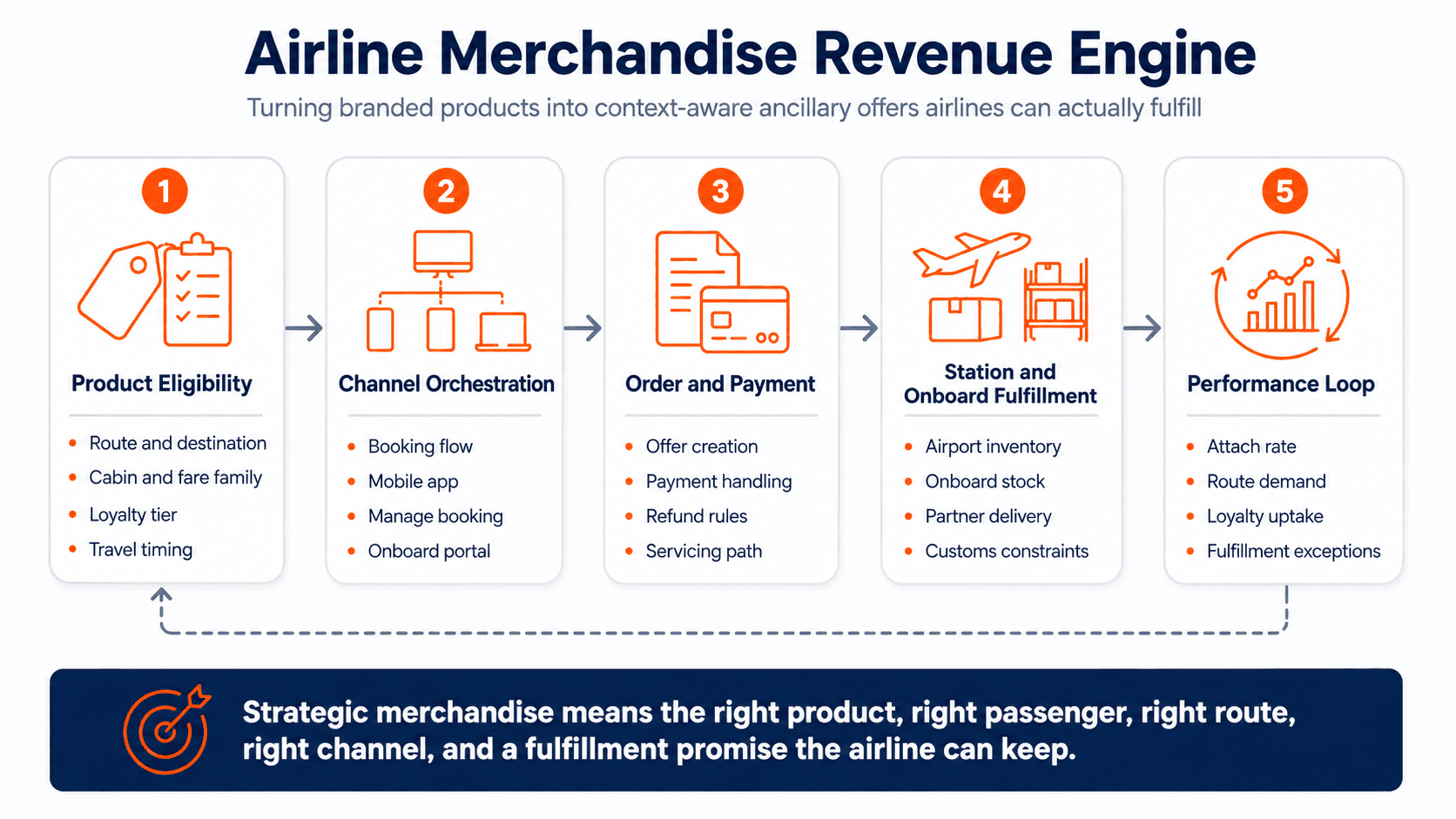
A practical way to frame the opportunity is the Offer-to-Fulfillment Airline Merchandise Model. It has five layers.
1. Product and eligibility design
Airlines need to define merchandise not only by SKU, price, image, and description, but also by eligibility rules. Which routes can sell it? Which cabins should see it? Is it available to all passengers or only loyalty members? Can it be offered pre-trip, onboard, or post-trip?
2. Channel orchestration
Merchandise should be available across the airline’s own channels where it makes sense: website, mobile app, booking flow, manage booking, check-in, loyalty portal, airport kiosk, onboard portal, and post-trip communication. Over time, airlines may also need to consider how selected merchandise appears through NDC-enabled channels.
3. Order and payment integration
Airline merchandise needs to connect to order management, payment, refunds, and servicing. In legacy environments, ancillaries often involve electronic miscellaneous documents, or EMDs. As the industry moves toward ONE Order, airlines have an opportunity to simplify how flight products, ancillaries, and merchandise are accounted for and serviced.
4. Station and onboard fulfillment
A merchandise promise is only as good as its fulfillment path. Airlines need visibility into whether the item will be delivered at the airport, stocked onboard, shipped after travel, or fulfilled by a partner. This becomes more complex across stations, aircraft rotations, customs rules, and airside versus landside retail environments.
5. Performance and learning loop
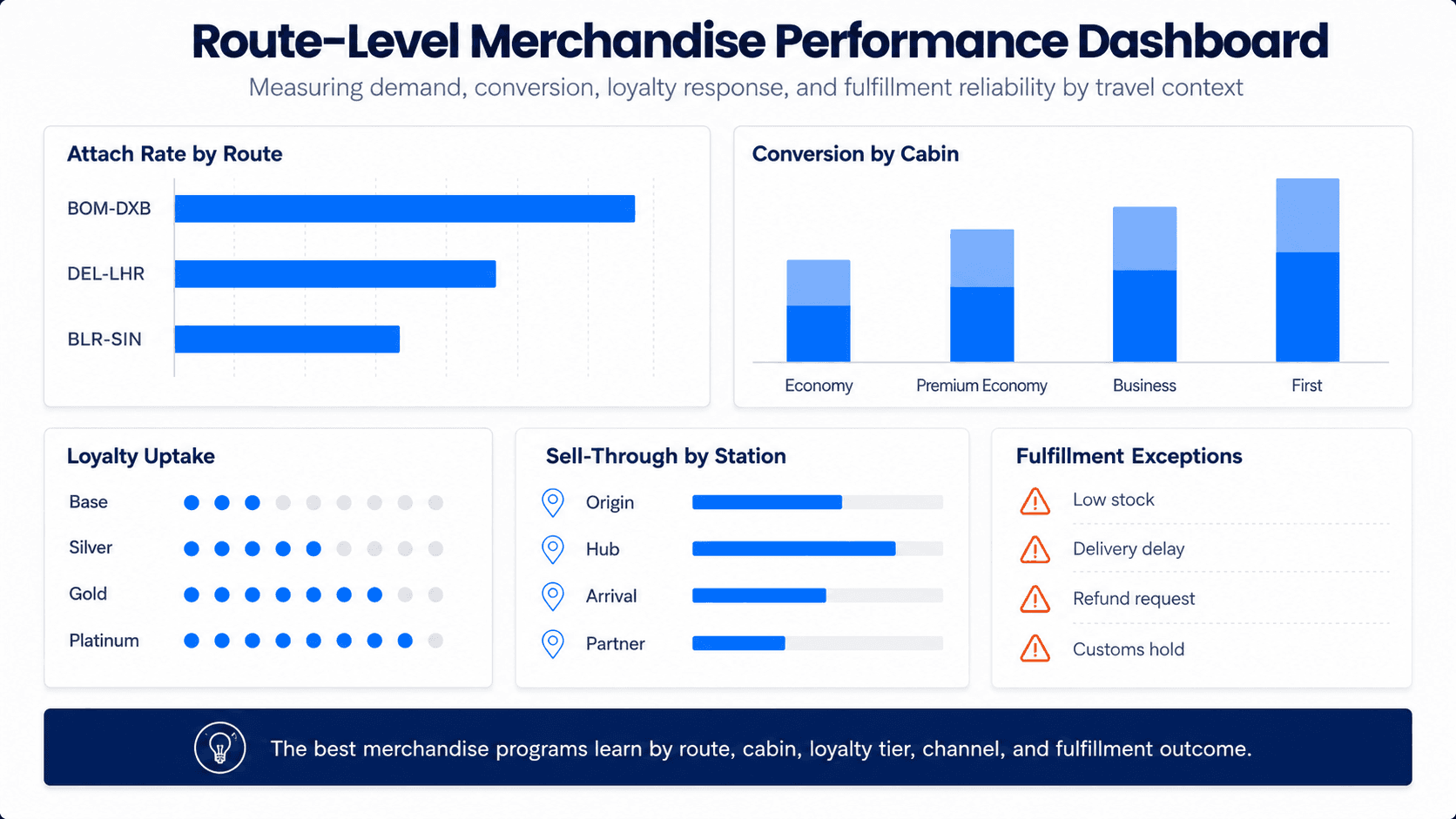
Airlines should measure merchandise like a retail product and like an airline ancillary. That means tracking attach rate, sell-through, margin, refund rate, fulfillment failure, route-level demand, cabin-level conversion, loyalty engagement, and campaign performance by flight segment.
The Technology Backbone Airlines Need
The biggest barrier is not imagination. Airlines know how to create desirable products. The harder part is connecting merchandise to systems that were not originally designed for modern retailing.
Many airlines still depend on legacy PSS, DCS, ticketing, loyalty, payment, and servicing environments. These systems are reliable and deeply embedded, but they can make new product experimentation slow. Adding merchandise into this environment requires careful integration, not a bolt-on storefront.
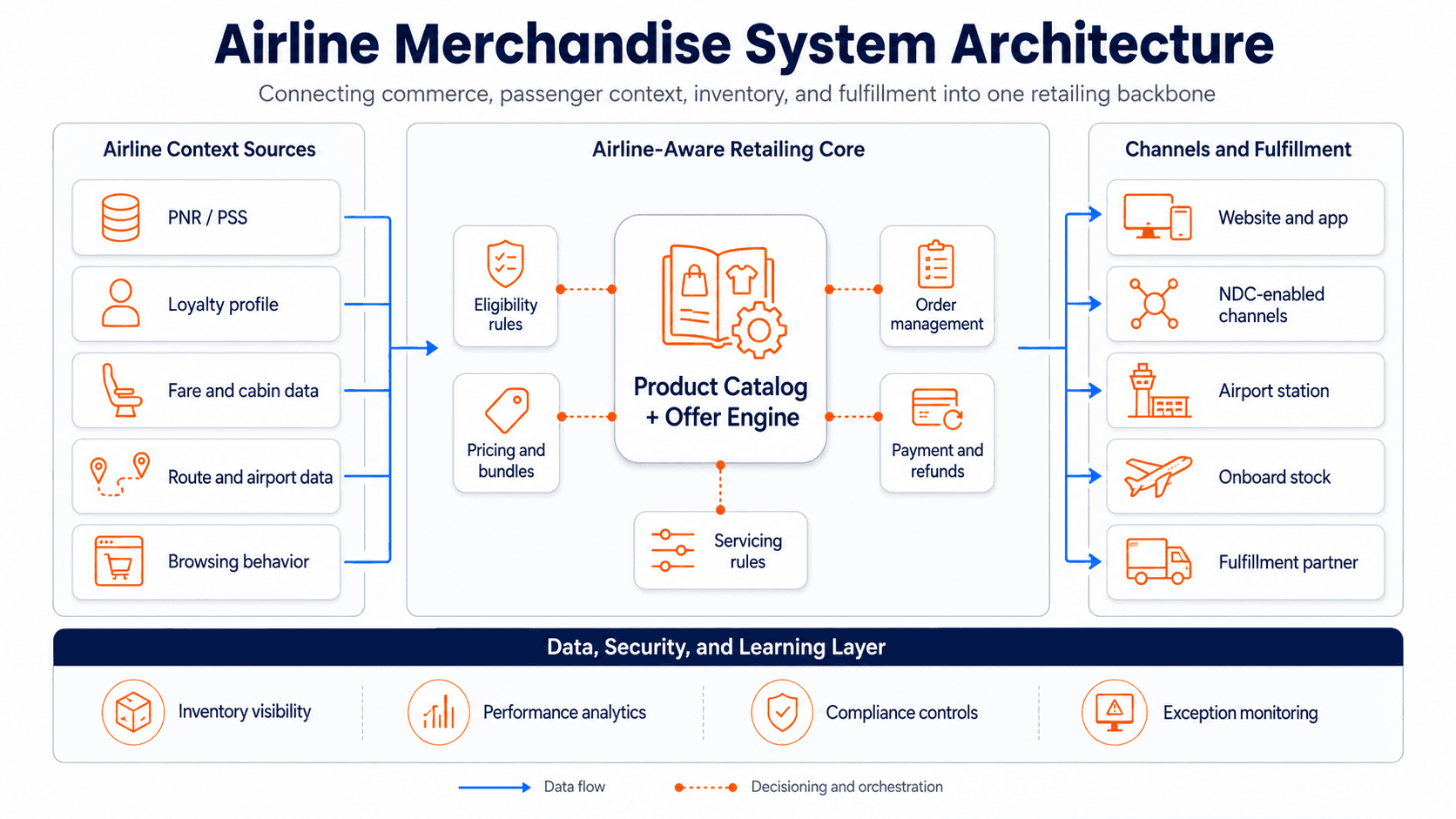
A modern airline merchandise capability needs:
an airline-aware product catalog
offer eligibility rules by route, fare family, cabin, and loyalty tier
integration with PNR and customer profile data
order and payment handling across direct channels
inventory visibility by station, warehouse, aircraft, or fulfillment partner
servicing rules for refunds, exchanges, failed fulfillment, and disruption scenarios
analytics that connect product performance to route, segment, cabin, loyalty, and channel
This is where data engineering services become important. Airlines need reliable pipelines that connect booking data, PNR attributes, loyalty profiles, browsing behavior, product performance, inventory movement, and fulfillment outcomes. Without that foundation, merchandise remains a static catalog rather than a dynamic ancillary opportunity.
Intelligent automation solutions can help reduce operational friction around supplier onboarding, product tagging, station replenishment, exception handling, return workflows, and low-stock alerts. For carriers working across older retailing and servicing platforms, cloud native application modernization can create the flexibility needed to connect merchandise across booking, app, airport, onboard, and post-trip channels.
Because airline retailing touches customer identity, payment data, loyalty status, and passenger records, data security and compliance must also be built into the operating model. Merchandise may feel light compared with ticketing, but once it connects to PNR, loyalty, payment, and fulfillment data, it becomes part of the airline’s regulated customer data environment.
Merchandise as a Loyalty and Brand Experience Lever
Merchandise can also strengthen loyalty strategy when it is treated as more than a transaction.
Airlines can create member-only product drops, anniversary collections, aircraft retirement collectibles, new route launch merchandise, destination capsules, and tier-based gifting. These offers can make loyalty feel more tangible, especially for passengers who may not always redeem points for upgrades or reward travel.
This also creates richer customer signals. If a passenger consistently buys aviation collectibles, premium travel gear, or destination-themed products, that behavior can inform future offers. If certain collections perform strongly on specific routes, the airline can adjust merchandising, destination marketing, and campaign planning.
This is where airline customer experience solutions need to connect commerce with customer understanding. The value is not only in the merchandise sale. It is in knowing which passengers respond to which products, at which point in the journey, and under which travel conditions.
Why Merchandise Belongs in the Airline Ancillary Strategy
Ancillary revenue is already central to airline economics. According to the Idea Works Company Car Trawler Ancillary Revenue Report, global airline ancillary revenue exceeded $100 billion in 2023, reflecting how central non-ticket revenue has become to airline economics., and modern airline retailing programs continue to push carriers toward more flexible Offer and Order capabilities. Most of the industry conversation focuses on seats, bags, bundles, upgrades, meals, and partner services. Merchandise deserves a place in that discussion because it can do something many ancillaries cannot: extend the airline brand beyond the flight.
A limited-edition route launch collection, a loyalty-exclusive aviation accessory, a destination-themed onboard product, or a premium branded travel kit can carry emotional value. It can also create commercial value if the airline knows when to offer it, to whom, through which channel, and with what fulfillment promise.
The challenge is that merchandise cannot be managed as a disconnected shop. If an airline wants to sell merchandise during booking, in the app, through loyalty campaigns, at airport retail points, onboard, or after the trip, it needs retailing capabilities that understand airline context.
That context is where the complexity starts.
The Airline-Specific Challenge: Eligibility, Context, and Fulfillment
In airline retailing, not every product is available to every passenger at every moment. That is true for seats and bags, and it becomes true for merchandise once the airline tries to scale it intelligently.
A merchandise offer may depend on:
route or destination
origin and arrival airport
international versus domestic travel
cabin class
fare family
loyalty tier
passenger type
aircraft type
airport station inventory
onboard availability
duty-free or customs restrictions
delivery or pickup feasibility
This makes airline merchandise very different from generic ecommerce. A passenger flying Mumbai to Dubai may be eligible for one merchandise collection, while a passenger flying Delhi to London may see a different set based on route, stock, campaign rules, and fulfillment options. A loyalty member may receive early access to a limited-edition product. A premium cabin passenger may see bundled merchandise with an amenity or onboard service. A passenger booking through an indirect channel may need a different offer and servicing path than someone booking directly through the airline app.
That level of decisioning requires more than a product page. It requires an airline-aware product catalog and offer engine.
The Offer-to-Fulfillment Model for Airline Merchandise
A practical way to frame the opportunity is the Offer-to-Fulfillment Airline Merchandise Model. It has five layers.
1. Product and eligibility design
Airlines need to define merchandise not only by SKU, price, image, and description, but also by eligibility rules. Which routes can sell it? Which cabins should see it? Is it available to all passengers or only loyalty members? Can it be offered pre-trip, onboard, or post-trip?
2. Channel orchestration
Merchandise should be available across the airline’s own channels where it makes sense: website, mobile app, booking flow, manage booking, check-in, loyalty portal, airport kiosk, onboard portal, and post-trip communication. Over time, airlines may also need to consider how selected merchandise appears through NDC-enabled channels.
3. Order and payment integration
Airline merchandise needs to connect to order management, payment, refunds, and servicing. In legacy environments, ancillaries often involve electronic miscellaneous documents, or EMDs. As the industry moves toward ONE Order, airlines have an opportunity to simplify how flight products, ancillaries, and merchandise are accounted for and serviced.
4. Station and onboard fulfillment
A merchandise promise is only as good as its fulfillment path. Airlines need visibility into whether the item will be delivered at the airport, stocked onboard, shipped after travel, or fulfilled by a partner. This becomes more complex across stations, aircraft rotations, customs rules, and airside versus landside retail environments.
5. Performance and learning loop
Airlines should measure merchandise like a retail product and like an airline ancillary. That means tracking attach rate, sell-through, margin, refund rate, fulfillment failure, route-level demand, cabin-level conversion, loyalty engagement, and campaign performance by flight segment.
The Technology Backbone Airlines Need
The biggest barrier is not imagination. Airlines know how to create desirable products. The harder part is connecting merchandise to systems that were not originally designed for modern retailing.
Many airlines still depend on legacy PSS, DCS, ticketing, loyalty, payment, and servicing environments. These systems are reliable and deeply embedded, but they can make new product experimentation slow. Adding merchandise into this environment requires careful integration, not a bolt-on storefront.
A modern airline merchandise capability needs:
an airline-aware product catalog
offer eligibility rules by route, fare family, cabin, and loyalty tier
integration with PNR and customer profile data
order and payment handling across direct channels
inventory visibility by station, warehouse, aircraft, or fulfillment partner
servicing rules for refunds, exchanges, failed fulfillment, and disruption scenarios
analytics that connect product performance to route, segment, cabin, loyalty, and channel
This is where data engineering services become important. Airlines need reliable pipelines that connect booking data, PNR attributes, loyalty profiles, browsing behavior, product performance, inventory movement, and fulfillment outcomes. Without that foundation, merchandise remains a static catalog rather than a dynamic ancillary opportunity.
Intelligent automation solutions can help reduce operational friction around supplier onboarding, product tagging, station replenishment, exception handling, return workflows, and low-stock alerts. For carriers working across older retailing and servicing platforms, cloud native application modernization can create the flexibility needed to connect merchandise across booking, app, airport, onboard, and post-trip channels.
Because airline retailing touches customer identity, payment data, loyalty status, and passenger records, data security and compliance must also be built into the operating model. Merchandise may feel light compared with ticketing, but once it connects to PNR, loyalty, payment, and fulfillment data, it becomes part of the airline’s regulated customer data environment.
Merchandise as a Loyalty and Brand Experience Lever
Merchandise can also strengthen loyalty strategy when it is treated as more than a transaction.
Airlines can create member-only product drops, anniversary collections, aircraft retirement collectibles, new route launch merchandise, destination capsules, and tier-based gifting. These offers can make loyalty feel more tangible, especially for passengers who may not always redeem points for upgrades or reward travel.
This also creates richer customer signals. If a passenger consistently buys aviation collectibles, premium travel gear, or destination-themed products, that behavior can inform future offers. If certain collections perform strongly on specific routes, the airline can adjust merchandising, destination marketing, and campaign planning.
This is where airline customer experience solutions need to connect commerce with customer understanding. The value is not only in the merchandise sale. It is in knowing which passengers respond to which products, at which point in the journey, and under which travel conditions.

Fig: Platform automation enables trusted DevOps practices.
Conclusion: Airline Merchandise Is a Retailing Capability, Not a Side Category
Airline merchandise has the potential to become a stronger ancillary revenue channel, but only if airlines stop treating it like a standalone souvenir program.
The opportunity is not simply to sell more branded products. It is to build a modern retailing capability that connects merchandise to passenger context, route eligibility, loyalty, inventory, fulfillment, payment, and servicing. That is what makes the airline case unique.
A hotel can sell merchandise through a simple ecommerce model. Airlines need to retail merchandise within a complex commercial and operational environment shaped by PNRs, fare rules, airport stations, loyalty tiers, aircraft operations, and evolving Offer-Order transformation.
The carriers that succeed will not be the ones with the largest merchandise catalog. They will be the ones that can offer the right product to the right passenger, on the right route, through the right channel, with a fulfillment promise they can actually keep.
Join our newsletter.
Smart reads, bold ideas and what’s next sent to you.
Resources
Join our newsletter.
Smart reads, bold ideas and what’s next sent to you.
Resources
Join our newsletter.
Smart reads, bold ideas and what’s next sent to you.
Resources