A person sits at a desk, viewing a computer screen displaying colorful bar graphs related to advertisement data.

From Test Execution to Release Gating: The New Mandate for QA Leads

From Test Execution to Release Gating: The New Mandate for QA Leads

Blog by Uma Bhat, Manager - SDET

Read: 5 min

Introduction 

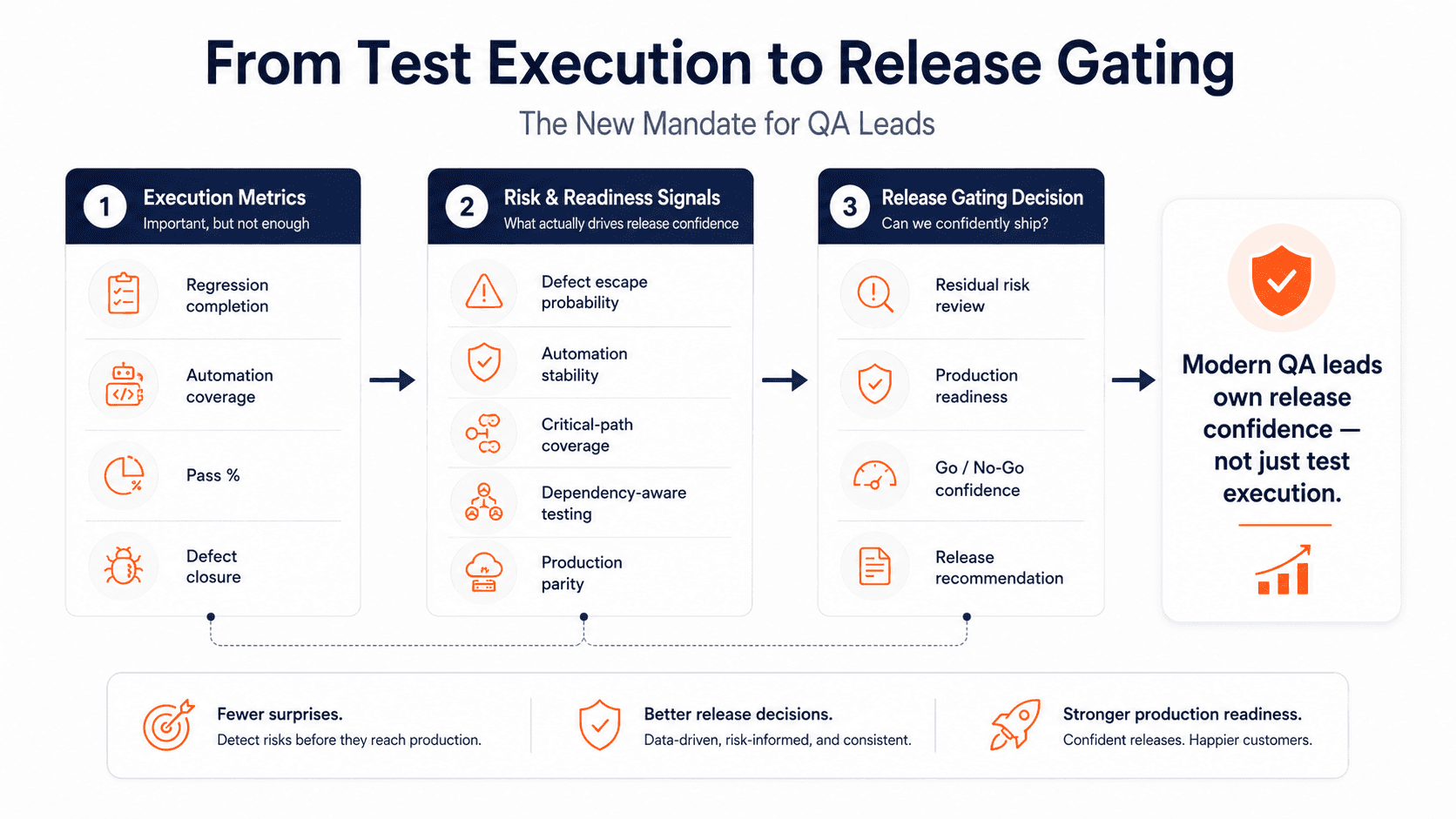
For years, QA leadership was largely measured through execution metrics regression completion, automation coverage, pass percentages, and defect closure trends. Those metrics still matter, but they no longer answer the most important release question: Can the organization confidently ship this release into production? 

Modern delivery environments have fundamentally changed the role of QA leadership. Releases now move through distributed microservices, CI/CD-driven deployment pipelines, unstable lower environments, third-party integrations, and compressed sprint timelines. Under these conditions, "testing is complete" is no longer a meaningful release signal. 

That is why QA leadership is evolving from test execution oversight into release of gating ownership. The modern QA lead is no longer just coordinating testing activities. The role increasingly involves evaluating residual risk, validating production readiness, interpreting automation reliability, identifying coverage blind spots, and contributing directly to go/no-go release decisions. 
Why Test Execution Status Is No Longer a Reliable Release Signal 

The core problem is false confidence created by execution-heavy reporting. A regression suite can report a 95% pass rate while critical business flows still carry high production risk. Flaky automation suites can generate false positives that distort CI pipeline stability. Sprint metrics can look healthy while unresolved dependency risk accumulates underneath the release. Experienced QA leaders understand that release confidence comes from signal reliability, not dashboard volume. Mature QE organizations increasingly focus on: 

  • Defect escape probability 

  • Automation stability trends 

  • Critical-path coverage depth 

  • Dependency-aware testing 

  • Production parity validation 

Fig: Metrics That Matter More Than Pass Percentage – A Release Confidence Framework for Modern QA Leadership
What QA Leads Actually Evaluate Before a Go/No-Go Decision 

A credible go/no-go recommendation is rarely based on regression completion alone. In real enterprise release cycles, QA leaders evaluate a much broader risk landscape before release signoff discussions begin. The assessment typically includes: 

  • unresolved Sev-1 and Sev-2 defects  

  • defects reopen trends and RCA patterns  

  • flaky automation instability  

  • SIT/UAT readiness alignment  

  • dependency validation across integrated systems  

  • rollback preparedness and recovery feasibility  

  • observability and production monitoring readiness post-deployment 

This is where QA leadership shifts from execution oversight to operational risk ownership. 

For example, a release may technically “pass” regression while still carrying elevated production risk because: 

  • downstream APIs were validated only against mocked services  

  • rollback scripts were never tested under production-scale conditions  

  • critical business workflows received only shallow coverage  

  • performance degradation remains unresolved under peak load  

  • data migration scenarios lack end-to-end verification  

A senior QA lead interprets these signals very differently from a traditional execution manager. 

The focus is not limited to:

  • pass/fail reporting  

  • execution tracking  

  • defect counts  

The real evaluation centers around:

  • residual risk exposure  

  • confidence depth across critical workflows  

  • release gate integrity  

  • operational readiness for production  

That distinction defines the difference between test management and true release-gating ownership. 

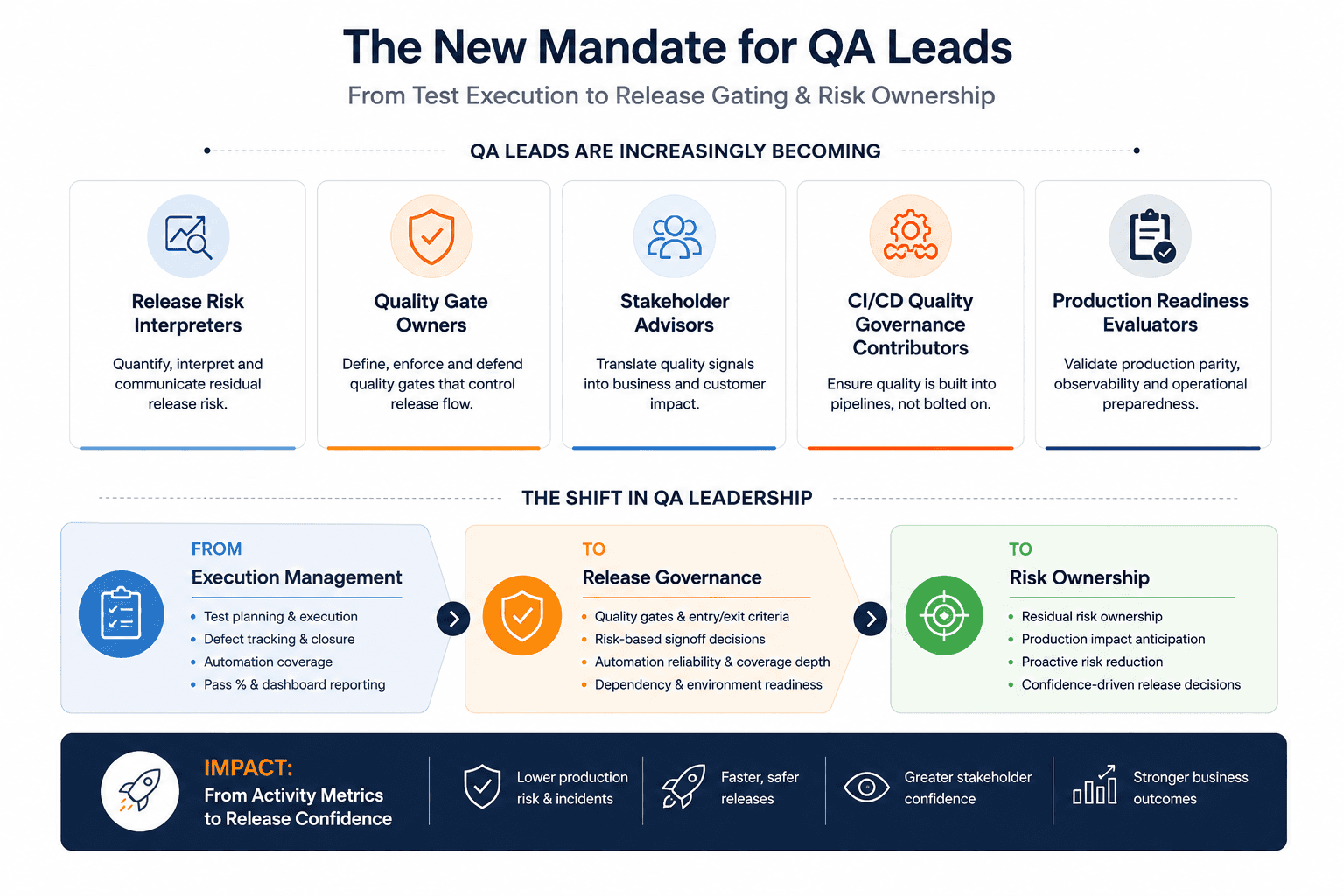
QA leads are increasingly becoming: 

  • release risk interpreters 

  • quality gate owners 

  • stakeholder advisors 

  • CI/CD quality governance contributors 

  • production readiness evaluators 

This evolution is being driven by modern delivery realities. High-frequency deployments, distributed architectures, platform dependencies, and accelerated sprint cadences have reduced the effectiveness of phase-based QA models. Testing can no longer function as an isolated downstream activity. Quality engineering now intersects directly with release orchestration, DevOps workflows, deployment governance, observability strategy, and incident prevention. 

The most mature QA organizations now expect QA leadership to quantify release risk, defend release signoff decisions, establish measurable quality gates, and provide leadership visibility into deployment confidence. The value of QA leadership is no longer measured only by execution efficiency it is measured by how effectively production risk is identified before customers experience it. 

What QA Leads Actually Evaluate Before a Go/No-Go Decision 

A credible go/no-go recommendation is rarely based on regression completion alone. In real enterprise release cycles, QA leaders evaluate a much broader risk landscape before release signoff discussions begin. The assessment typically includes: 

  • unresolved Sev-1 and Sev-2 defects  

  • defects reopen trends and RCA patterns  

  • flaky automation instability  

  • SIT/UAT readiness alignment  

  • dependency validation across integrated systems  

  • rollback preparedness and recovery feasibility  

  • observability and production monitoring readiness post-deployment 

This is where QA leadership shifts from execution oversight to operational risk ownership. 

For example, a release may technically “pass” regression while still carrying elevated production risk because: 

  • downstream APIs were validated only against mocked services  

  • rollback scripts were never tested under production-scale conditions  

  • critical business workflows received only shallow coverage  

  • performance degradation remains unresolved under peak load  

  • data migration scenarios lack end-to-end verification  

A senior QA lead interprets these signals very differently from a traditional execution manager. 

The focus is not limited to:

  • pass/fail reporting  

  • execution tracking  

  • defect counts  

The real evaluation centers around:

  • residual risk exposure  

  • confidence depth across critical workflows  

  • release gate integrity  

  • operational readiness for production  

That distinction defines the difference between test management and true release-gating ownership. 

QA leads are increasingly becoming: 

  • release risk interpreters 

  • quality gate owners 

  • stakeholder advisors 

  • CI/CD quality governance contributors 

  • production readiness evaluators 

This evolution is being driven by modern delivery realities. High-frequency deployments, distributed architectures, platform dependencies, and accelerated sprint cadences have reduced the effectiveness of phase-based QA models. Testing can no longer function as an isolated downstream activity. Quality engineering now intersects directly with release orchestration, DevOps workflows, deployment governance, observability strategy, and incident prevention. 

The most mature QA organizations now expect QA leadership to quantify release risk, defend release signoff decisions, establish measurable quality gates, and provide leadership visibility into deployment confidence. The value of QA leadership is no longer measured only by execution efficiency it is measured by how effectively production risk is identified before customers experience it. 

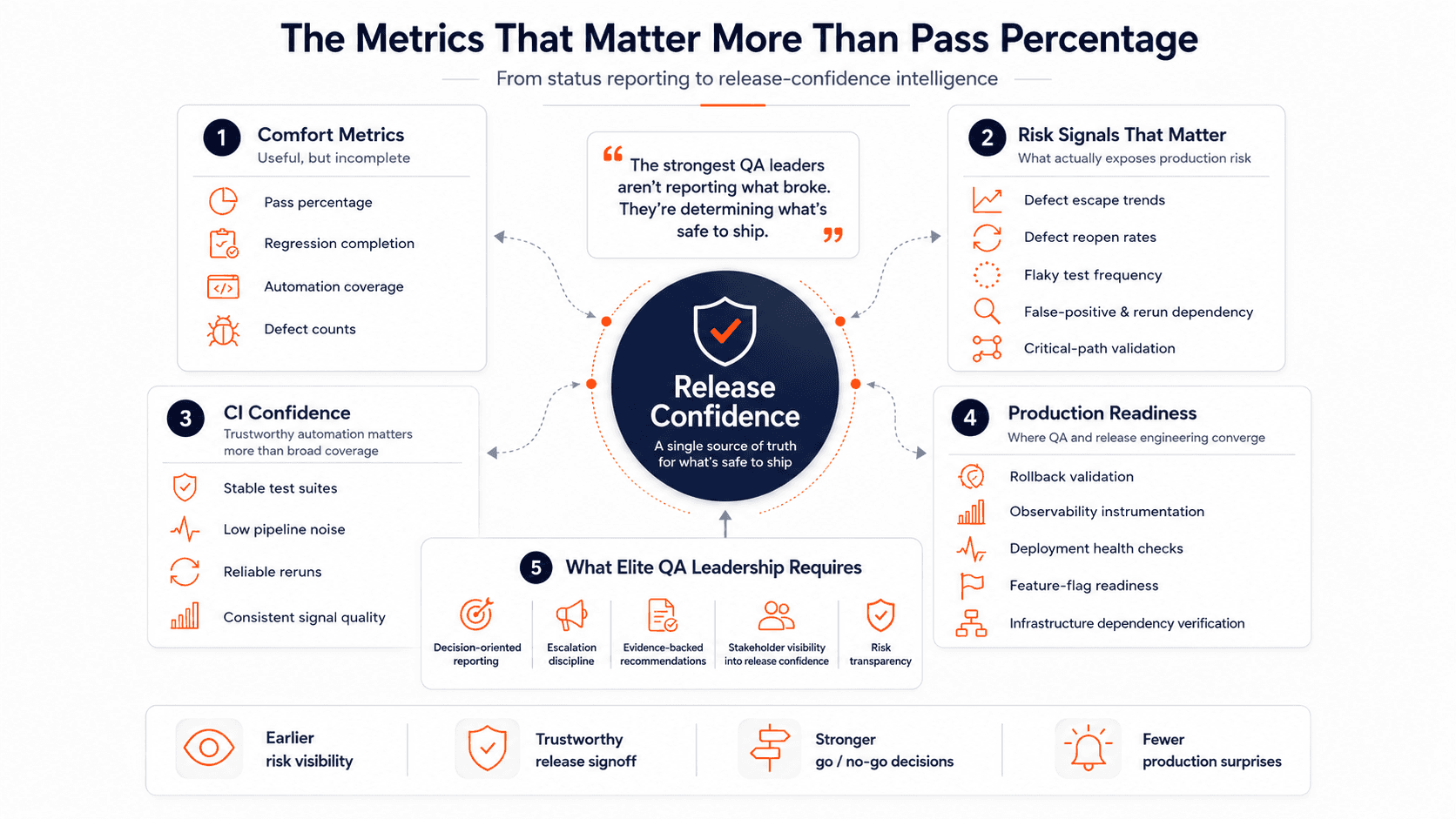
The Metrics That Matter More Than Pass Percentage 

Pass percentage is a comfort metric it tells you what finished, not what's at risk. Modern QA leadership demands a sharper lens. 

Execution-heavy reporting generates noise. The metrics that drive release confidence are the ones that expose risk before it reaches production. 

Defect escape trends are a diagnostic signal, not just a count. Persistent escapes point to specific breakdowns: shallow coverage depth, underdeveloped exploratory testing, low-fidelity environments, or gaps in critical-flow validation. The trend line matters more than the individual defect. 

Defects reopen rates are equally telling. High reopen frequency typically traces back to unstable requirements, incomplete fixes, weak regression targeting, or poor traceability discipline any of which can silently undermine release quality long before a sign-off conversation begins. 

Automation coverage percentages lose meaning when the underlying suite is unreliable. A flaky test isn't coverage it's noise with a green checkbox. High-performing QE teams track what actually governs CI confidence: 

  • Flaky test frequency 

  • Rerun dependency rates 

  • False-positive rates 

  • Unstable pipeline behavior 

Reducing automation noise is a prerequisite for trustworthy release signoff, not an afterthought. 

The most consequential shift in QA strategy is the move from broad, shallow coverage to critical-path validation. Elite QA organizations align test depth directly to business risk revenue flows, compliance obligations, customer trust, and operational continuity. That means payment flows, checkout journeys, authentication paths, transaction orchestration, and compliance-sensitive workflows get disproportionate rigor. Everything else gets right sized. 

Finally, production readiness has become a QA concern, not just an ops concern. Release gating now routinely includes rollback validation, observability instrumentation, deployment health checks, feature-flag readiness, and infrastructure dependency verification. This is where QA engineering and release engineering converge and where the most mature teams are operating today. 

That's why elite QA leadership today requires: 

  • Decision-oriented reporting — not status updates, but clear go/no-go framing 

  • Escalation discipline — knowing when to hold the line, and doing it 

  • Evidence-backed recommendations — so pushback carries weight 

  • Stakeholder visibility into release confidence — not just defect counts 

  • Risk transparency — even when it's uncomfortable 

The strongest QA leaders aren't reporting what broke. They're determining what's safe to ship. 

Conclusion:

QA leadership has crossed a threshold. Regression completion, pass rates, and automation coverage are table stakes necessary but no longer sufficient.

Enterprise teams now expect QA leaders to own a harder question: Is this product safe to release? Not "did tests pass," but "do we understand what we don't know, and are we prepared to defend that decision in production?" 

That shift from execution tracking to release gating ownership is the defining evolution of the role. The QA leaders who thrive in this environment aren't coordinating test cycles. They're preventing the kind of production failures that end quarters, damage customers, and erode trust in engineering. 

They don't wait for production to find the risk. They make sure the organization sees it first.