A person sits at a desk, viewing a computer screen displaying colorful bar graphs related to advertisement data.

How to Build a Hotel AI Concierge Guests Can Trust

How to Build a Hotel AI Concierge Guests Can Trust

Surya Teja, Senior Business Analyst, Zapcom

Read: 5 min

Introduction 

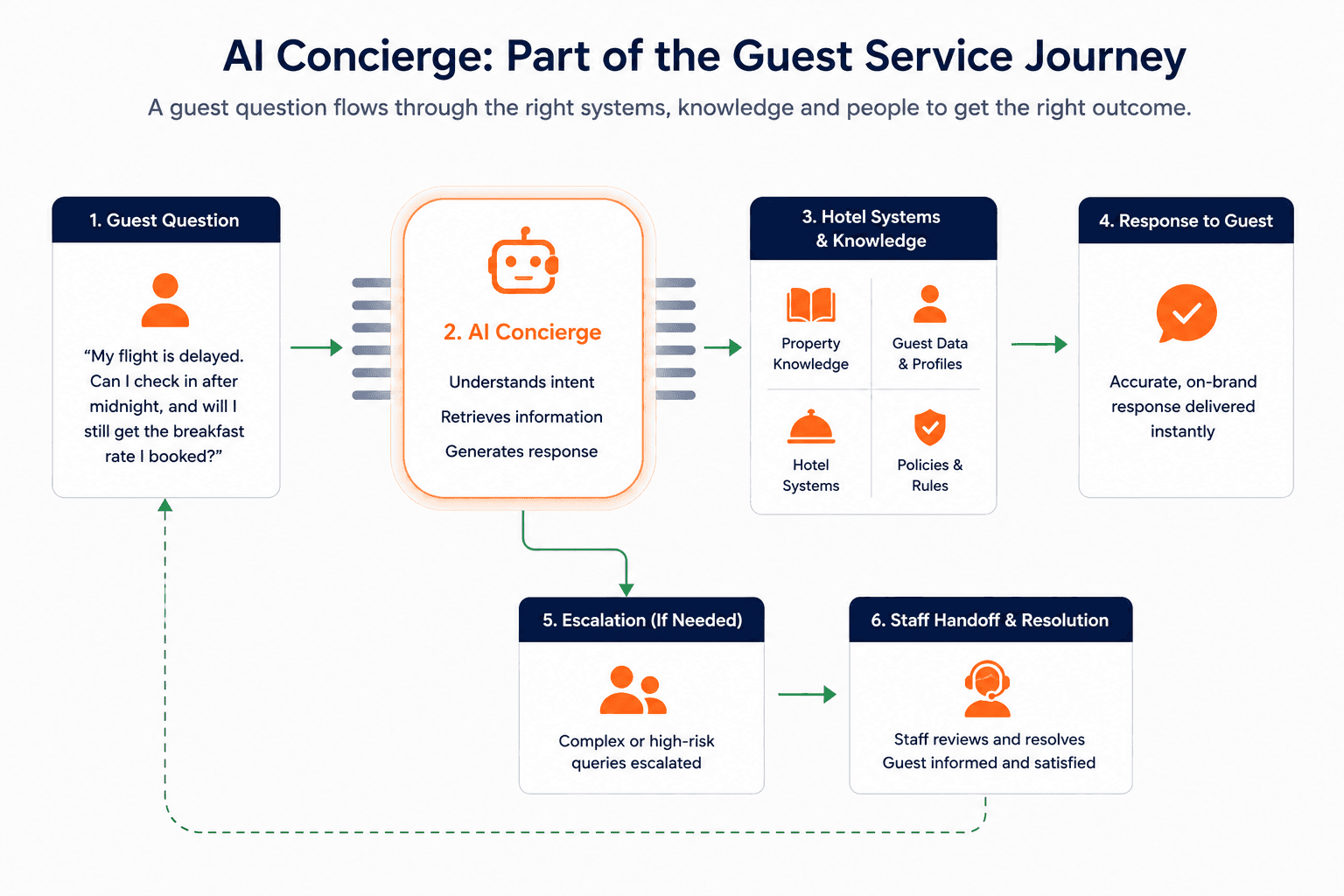
A hotel AI concierge can look impressive in a demo. Ask it what time the pool opens, and it responds instantly with a polished, on-brand answer. Leadership sees speed, consistency, and a clear path to automating repetitive guest questions. Real guests are less predictable. They ask layered questions: “My flight is delayed. Can I check in after midnight, and will I still get the breakfast rate I booked?” If the assistant answers confidently with a policy that does not exist, the problem is no longer technical. The hotel has created a guest-service promise it may now have to unwind at the front desk. That is why a hospitality AI concierge should be managed as a product, not a model demo. The model matters, but it is rarely the first failure point. Stale property knowledge, fragmented guest data, weak guardrails, unclear escalation rules, and shallow testing are what turn a promising assistant into a brand risk. 

For product leaders in hospitality, the real question is not “Which model should we use?” It is “What must be true before this assistant is safe, useful, and trustworthy in front of guests?” 
The AI Concierge Is a Product, Not a Demo

The first mistake many hotel teams make is starting with the model. A generative AI assistant can sound fluent almost immediately, which makes it easy to believe the hard work is already done. But hospitality AI succeeds only when three layers work together: data, model behavior, and guest experience. Data sits at the bottom of that stack. The concierge needs accurate policies, current room and rate information, property-specific amenities, loyalty context, and reservation data. Without that foundation, even the strongest model can produce confident but wrong answers. 

The model layer comes next. This includes prompting, retrieval, guardrails, refusal behavior, and the logic that determines when the assistant should answer and when it should escalate. 

The guest experience layer is where the product earns trust. The assistant must respond in the right tone, understand messy guest language, support multiple channels, and hand off cleanly when a human needs to step in. A hotel does not need a chatbot that sounds clever. It needs a concierge that behaves responsibly in real service moments. 
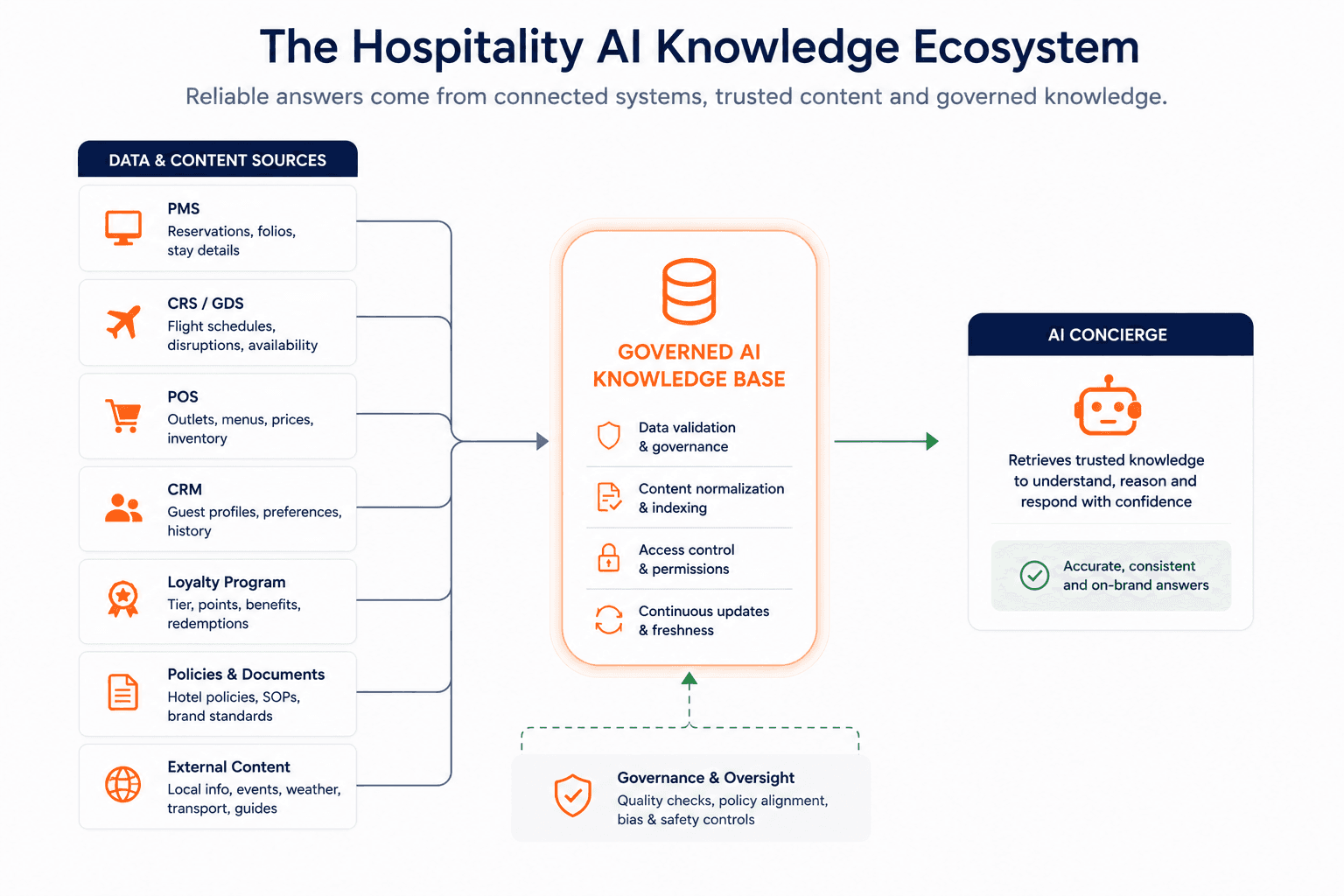
Fig: Managing AI Concierge Risks Through Layered Controls

Start With Product Framing Before Technology 

Before teams build, integrate, or prompt anything, the product manager must turn a broad business complaint into a usable product scope. 

"Our front desk is overloaded” is a real pain point, but it is not yet a product brief. A stronger scope would be: build an AI concierge that can resolve the top 20 guest questions and 5 routine service requests, including late checkout, extra towels, restaurant bookings, amenity information, and basic reservation support across web, app, and WhatsApp, with clean escalation to hotel staff when the assistant cannot answer safely. That framing gives engineering, operations, and leadership something measurable to work toward. 

The most useful metrics are not model scores alone. They are operational and commercial indicators the hotel already cares about:

  • Containment rate: how many conversations are resolved without staff intervention 

  • Guest CSAT: whether guests are satisfied with the bot-assisted experience 

  • Escalation quality: whether handoffs are timely, contextual, and useful 

  • Staff time saved: how much repetitive service load is reduced 

  • Ancillary revenue: whether the assistant supports upgrades, late checkout, dining, spa, or direct booking opportunities 

If the AI concierge cannot connect to one or more of these outcomes, it is not yet a product. It is an experiment with a chat interface. 

Bad Knowledge Creates Confidently Wrong Answers 

The most common failure point in hospitality AI is not weak language generation. It is unreliable knowledge. Hotels often operate across fragmented systems: PMS, CRS, POS, CRM, loyalty platforms, booking engines, channel managers, and property-level documents. Policies may live in PDFs, emails, shared drives, vendor portals, or the memory of experienced front-desk staff. Room types and rate codes may be named differently across systems. Guest profiles may be duplicated or incomplete. 

For staff, these issues are inconvenient. For an AI concierge, they are dangerous. A generative assistant will try to be helpful even when its knowledge is incomplete. If it is pointed at stale, contradictory, or poorly governed information, it may answer with confidence instead of uncertainty. 

Common data risks include: 

  • Stale policy documents: the assistant gives an outdated cancellation or breakfast policy. 

  • Duplicate guest profiles: a returning guest is treated as unknown or linked to the wrong record.  

  • Inconsistent rate and room data: the bot gives answers that conflict with the hotel website or booking engine. 

  • Scattered operational knowledge: the assistant fills gaps with plausible but unapproved responses. 

This is why data engineering services matter before the AI experience goes live. Hotels need trusted knowledge flows, not just a polished chatbot layer over fragmented information. 

How to Give the AI Concierge Reliable Knowledge 

A guest-facing concierge needs a governed knowledge pipeline. The assistant should not be left to “figure out” hotel policies from loose documents or disconnected data sources. Product leaders must define what the bot can know, where that knowledge comes from, and how quickly it is updated. 

A practical approach usually includes three priorities: 

  • Build an approved hotel knowledge base: policies, amenities, service hours, room information, loyalty rules, and common guest workflows should have clear ownership.  

  • Use retrieval-augmented generation: the assistant should ground answers in approved sources instead of relying on the model’s general knowledge. 

  • Set freshness rules: when a policy, rate condition, amenity, or service window changes, the assistant’s knowledge must update quickly. 

Most hotel teams do not need to train a model from scratch. They need to configure a strong foundation model, ground it in hotel-specific knowledge, and use guardrails to control what it can say and do. Fine-tuning may help later for tone or recurring edge cases, but it should not be used to compensate for poor knowledge governance. 

This is where intelligent automation solutions and strong data foundations work together. Automation becomes useful only when the assistant can act on trusted information. 

Start With Product Framing Before Technology 

Before teams build, integrate, or prompt anything, the product manager must turn a broad business complaint into a usable product scope. 

"Our front desk is overloaded” is a real pain point, but it is not yet a product brief. A stronger scope would be: build an AI concierge that can resolve the top 20 guest questions and 5 routine service requests, including late checkout, extra towels, restaurant bookings, amenity information, and basic reservation support across web, app, and WhatsApp, with clean escalation to hotel staff when the assistant cannot answer safely. That framing gives engineering, operations, and leadership something measurable to work toward. 

The most useful metrics are not model scores alone. They are operational and commercial indicators the hotel already cares about:

  • Containment rate: how many conversations are resolved without staff intervention 

  • Guest CSAT: whether guests are satisfied with the bot-assisted experience 

  • Escalation quality: whether handoffs are timely, contextual, and useful 

  • Staff time saved: how much repetitive service load is reduced 

  • Ancillary revenue: whether the assistant supports upgrades, late checkout, dining, spa, or direct booking opportunities 

If the AI concierge cannot connect to one or more of these outcomes, it is not yet a product. It is an experiment with a chat interface. 

Bad Knowledge Creates Confidently Wrong Answers 

The most common failure point in hospitality AI is not weak language generation. It is unreliable knowledge. Hotels often operate across fragmented systems: PMS, CRS, POS, CRM, loyalty platforms, booking engines, channel managers, and property-level documents. Policies may live in PDFs, emails, shared drives, vendor portals, or the memory of experienced front-desk staff. Room types and rate codes may be named differently across systems. Guest profiles may be duplicated or incomplete. 

For staff, these issues are inconvenient. For an AI concierge, they are dangerous. A generative assistant will try to be helpful even when its knowledge is incomplete. If it is pointed at stale, contradictory, or poorly governed information, it may answer with confidence instead of uncertainty. 

Common data risks include: 

  • Stale policy documents: the assistant gives an outdated cancellation or breakfast policy. 

  • Duplicate guest profiles: a returning guest is treated as unknown or linked to the wrong record.  

  • Inconsistent rate and room data: the bot gives answers that conflict with the hotel website or booking engine. 

  • Scattered operational knowledge: the assistant fills gaps with plausible but unapproved responses. 

This is why data engineering services matter before the AI experience goes live. Hotels need trusted knowledge flows, not just a polished chatbot layer over fragmented information. 

How to Give the AI Concierge Reliable Knowledge 

A guest-facing concierge needs a governed knowledge pipeline. The assistant should not be left to “figure out” hotel policies from loose documents or disconnected data sources. Product leaders must define what the bot can know, where that knowledge comes from, and how quickly it is updated. 

A practical approach usually includes three priorities: 

  • Build an approved hotel knowledge base: policies, amenities, service hours, room information, loyalty rules, and common guest workflows should have clear ownership.  

  • Use retrieval-augmented generation: the assistant should ground answers in approved sources instead of relying on the model’s general knowledge. 

  • Set freshness rules: when a policy, rate condition, amenity, or service window changes, the assistant’s knowledge must update quickly. 

Most hotel teams do not need to train a model from scratch. They need to configure a strong foundation model, ground it in hotel-specific knowledge, and use guardrails to control what it can say and do. Fine-tuning may help later for tone or recurring edge cases, but it should not be used to compensate for poor knowledge governance. 

This is where intelligent automation solutions and strong data foundations work together. Automation becomes useful only when the assistant can act on trusted information. 

Security and Governance Are Product Requirements 

A hotel AI concierge can touch sensitive guest data and make statements that guests may treat as commitments. That raises the stakes. 

If the assistant connects to the PMS, CRM, loyalty platform, or payment-adjacent workflows, it must be tightly scoped. It should only access the data needed for the specific guest interaction, and it should never reveal another guest’s information, payment details, internal notes, or private booking context. 

It also needs clear policy boundaries. "Yes, you can cancel for free" is not just an answer. It is a commitment. "You have been upgraded" is not just a friendly response. It can create an operational expectation the property may not be able to fulfill. 

Governance must cover: 

  • What the assistant can access?

  • What it can reveal? 

  • When it must escalate? 

  • How conversations are logged and reviewed? 

  • How guest consent and privacy obligations are handled? 

For hotels operating across regions, this also intersects with GDPR, CCPA, PCI-DSS, data residency, and internal compliance policies. Data security and compliance should therefore be part of product design from the beginning, not an after-launch review. 

The Timeline Is Driven by Data, Integration, and Testing 

One of the most common leadership questions is: how long does it take to train the chatbot? 

For most hotel AI concierge programs, that is the wrong question. The team usually does not train a model from zero. It uses a foundation model, connects it to property-specific knowledge, designs conversation flows, integrates with hotel systems, and evaluates performance continuously. 

A realistic delivery path looks like this: 

Discovery and scope: Identify guest intents, define success metrics, audit available knowledge, and decide what the assistant should not handle yet. 

Knowledge and prototype: Clean and structure hotel information, create a retrieval layer, draft prompts, and test early flows using realistic guest questions. 

Development and integration: Connect to systems such as PMS, CRM, loyalty, or service-ticketing tools where appropriate. Build escalation logic, multilingual support, analytics, and staff workflows. 

Continuous improvement: Monitor real conversations, identify failed intents, update knowledge, tune guardrails, and expand capabilities over time. 

The model is only one part of the timeline. The heavier work is usually data readiness, integration, evaluation, and operational rollout. Hotels that plan for this reality are less likely to overpromise and more likely to launch responsibly.

Evaluating AI Concierge Performance in Real-World Scenarios 

A traditional software feature can often be tested against expected inputs and outputs. A generative AI concierge is different. Guests phrase the same question in hundreds of ways, mix multiple requests into one message, use slang or typos, switch languages, and sometimes ask for things the hotel should not promise. 

Testing must therefore go beyond five friendly demo questions. 

A serious evaluation strategy should include: 

  • Groundedness testing: Does the answer match approved hotel knowledge? 

  • Edge-case testing: Can the assistant handle delayed flights, disputed bookings, accessibility needs, allergies, or angry guests? 

  • Adversarial testing: Can users manipulate the bot into revealing data, ignoring policy, or promising freebies? 

Tone is also part of correctness. The answer may be factually accurate but still fail if it sounds cold, defensive, overly casual, or too willing to make commitments. For hospitality, brand safety is not just about avoiding offensive language. It is about protecting trust in moments where guests may already be stressed. Testing also has to continue after launch. A prompt change that improves one scenario can weaken another. A property policy may change. A model provider may update behavior. New guest questions may expose missing knowledge. The product team needs a regression evaluation set that runs repeatedly, including after prompt updates and knowledge-base changes. 

AI Product Delivery Needs an Experimental Operating Model 

AI concierge programs do not always fit neatly into traditional delivery expectations. Teams can plan integrations, milestones, and rollout phases, but the quality of responses improves through iteration: observe, evaluate, adjust, and test again. 

That does not mean the program should be unstructured. It means the operating model should be evidence-led. Product managers, engineers, data specialists, conversation designers, hotel operations teams, and compliance stakeholders need to work from shared evaluation results, not subjective opinions about whether the bot “sounds good.” 

The strongest teams treat each change as a controlled product experiment. They update a prompt, modify retrieval logic, add a policy source, or change an escalation rule, then measure whether the assistant became safer, faster, more useful, or more accurate. 

This is where a partner with experience in travel hospitality technology solutions, automation, data, and platform modernization can help hotels move from AI experimentation to production-grade guest experience design. 

Conclusion 

The hotel that wins with an AI concierge will not be the one with the most impressive demo. It will be the one that treats the concierge as a governed, measurable, guest-facing product. 

That means starting with the right scope, cleaning and governing hotel knowledge, grounding the assistant in approved sources, securing access to guest data, defining escalation rules, and testing against the way guests actually communicate: multilingual, emotional, unpredictable, and sometimes adversarial. 

When a guest’s flight is delayed and they ask whether they can check in late without losing their booked breakfast rate, the assistant should not improvise. It should know the policy, understand the reservation context, respond in the hotel’s voice, and escalate when needed. 

That is the difference between launching a chatbot and building a trustworthy AI concierge.