Blog by Anurag M, Engineering Manager
Read: 5 min
Introduction
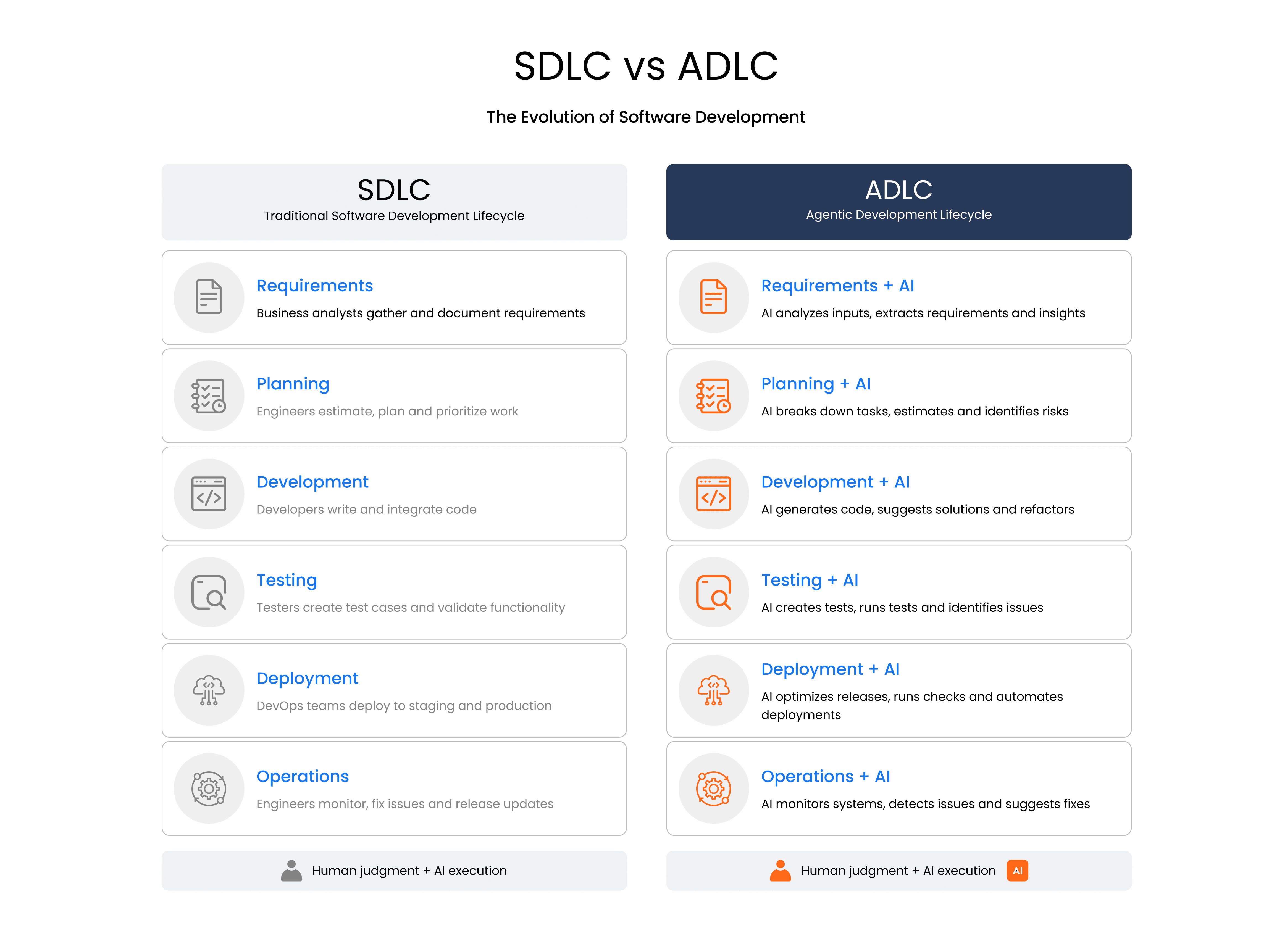
For years, the Software Development Lifecycle (SDLC) has been the backbone of modern engineering organizations. Requirements moved through planning, development, testing, deployment, and maintenance in a structured flow built almost entirely around human execution. Developers wrote code, testers validated releases, DevOps teams handled deployments, and managers coordinated everything through tickets, sprint rituals, and delivery timelines.
That operating model is now evolving faster than most organizations expected.We are entering the era of the Agentic Development Lifecycle (ADLC), where AI systems are no longer limited to assisting developers with autocomplete suggestions. Agents are beginning to participate across the entire engineering lifecycle reading requirements, generating code, running tests, reviewing pull requests, and even suggesting fixes when production systems fail.This shift is larger than a tooling upgrade. It changes how software teams scale, how engineering managers operate, and what skills remain valuable inside modern organizations.
AI Is Moving Beyond Coding Assistants
The first wave of AI adoption in engineering focused heavily on code generation. Tools like GitHub Copilot, Cursor, Claude Code, and autonomous coding agents demonstrated that large portions of implementation work could be automated faster than many teams anticipated, but the real transformation is not that AI can write code. The real transformation is that software delivery itself is becoming agent-driven.Today, an engineering agent can:
Read a Jira ticket
Understand repository context
Generate implementation plans
Write and refactor code
Execute tests
Open pull requests
Detect linting issues
Analyze deployment failures
That means engineering workflows are no longer centered entirely around human throughput. Increasingly, they revolve around how effectively organizations can orchestrate intelligent systems.
This is where the idea of ADLC becomes important. The traditional SDLC optimized coordination between humans. ADLC optimizes coordination between humans and autonomous systems working together. Organizations investing in application modernization, cloud-native platforms, and intelligent automation are already creating the foundation required for this transition. AI-driven development works best when workflows, environments, and delivery pipelines are modernized enough to support autonomous execution safely and consistently.
The Biggest Bottleneck Is No Longer Coding
One of the most important lessons emerging from AI-driven development is that coding itself was never the hardest part of software engineering. Clarity was. A senior engineer succeeds because they can take ambiguity and convert it into structured execution. AI agents behave in surprisingly similar ways. When given a narrow scope, clear acceptance criteria, repository access, and proper validation systems, agents perform remarkably well. When given vague instructions or missing context, they fail the same way inexperienced engineers do confidently and incorrectly. This is why the most valuable engineering skill in the ADLC era is not “prompt engineering.” It is structured thinking. The engineers and managers who thrive are the ones who can:
Break problems into well-scoped tasks
Define outcomes clearly
Create strong feedback loops
Design verification systems
Anticipate edge cases early
Write precise implementation briefs
In many ways, AI is exposing weaknesses that already existed in engineering execution. Teams that relied on vague tickets, informal communication, or “figure it out later” processes struggle significantly more with agents because agents depend heavily on operational clarity. Ironically, the management discipline many organizations neglected for years is suddenly becoming critical infrastructure.
Managing Agents Looks a Lot Like Managing Engineers
One of the more surprising realizations in modern engineering teams is how closely agent management resembles people management. Hand a non-trivial task to a coding agent today, and it may complete the work, open the PR, and move to the next task without asking for updates or clarification. But when the outcome is poor, the issue is often not the model itself it is the management structure around it. The same things that make engineers effective also make agents effective:
Clear scope definition
Good documentation
Strong tooling access
Fast feedback cycles
Reliable testing systems
Observable success criteria
The same things that break engineers break agents even harder:
Fuzzy requirements
Missing permissions
Incomplete context
Weak validation
Undefined ownership
The failure modes also feel familiar. Agents hallucinate in the same way junior engineers overcommit during sprint planning specific, confident, and wrong. The solution is also surprisingly similar: force visibility into reasoning and verification. Strong engineering teams are increasingly asking agents for:
Plans before implementation
Tests before fixes
Rollback strategies before deployments
Validation steps before merges
When paired with linting systems, CI pipelines, observability tooling, and structured review processes, agents become surprisingly disciplined contributors. Without those systems, they become fast generators of technical chaos.
QA and Deployments Are Already Changing
If there is one area where ADLC is becoming immediately visible, it is Quality Assurance. Manual QA testing is rapidly shifting from human execution toward autonomous verification. Modern testing agents can already read requirements, generate test cases, execute browser validations, identify regressions, and file reproducible bug reports automatically. This is no longer a future prediction. It is actively happening inside engineering organizations today. The economics are difficult to ignore:
Higher test coverage
Faster regression cycles
Lower operational cost
Continuous execution at scale
As a result, QA roles themselves are evolving upward. The repetitive execution layer is shrinking, while the human role becomes more focused on:
Quality strategy
Risk prioritization
User experience validation
Compliance oversight
Edge-case judgment
Deployments are undergoing a similar transformation. CI/CD pipelines automated release execution years ago, but ADLC extends automation into operational decision-making itself. Agents can now:
Monitor production telemetry
Detect anomalies
Analyze logs
Suggest rollbacks
Generate incident summaries
Open remediation tasks automatically
The deployment lifecycle is evolving from: “Build → test → deploy” into “Validate → simulate → deploy → observe → self-correct”. Human engineers increasingly supervise systems instead of manually operating them. Organizations building cloud-native delivery environments and secure engineering workflows will have a significant advantage as AI-assisted deployment models mature further.
The Engineering Organization Is Being Rewritten
The long-term impact of ADLC is not simply faster development cycles. It is a restructuring of engineering organizations themselves. Traditional scaling models assumed:
More engineers meant more output
More QA meant more coverage
More coordinators meant better execution
AI changes those assumptions because agent throughput scales differently. Human productivity is constrained by hours and cognitive bandwidth. Agent productivity is constrained primarily by clarity of instruction, validation systems, and operational design. That creates enormous leverage for organizations that adapt early. Engineering teams of the future will likely:
Operate with fewer execution-heavy roles
Emphasize architecture and systems thinking
Depend heavily on orchestration workflows
Prioritize judgment over implementation speed
Measure leverage differently than headcount
The engineering manager’s role evolves alongside this transition. Managers are no longer coordinating only humans. Increasingly, they are designing systems where humans and agents collaborate effectively and unlike people, agents do not respond to charisma, optimism, or vague direction. They respond to clarity.
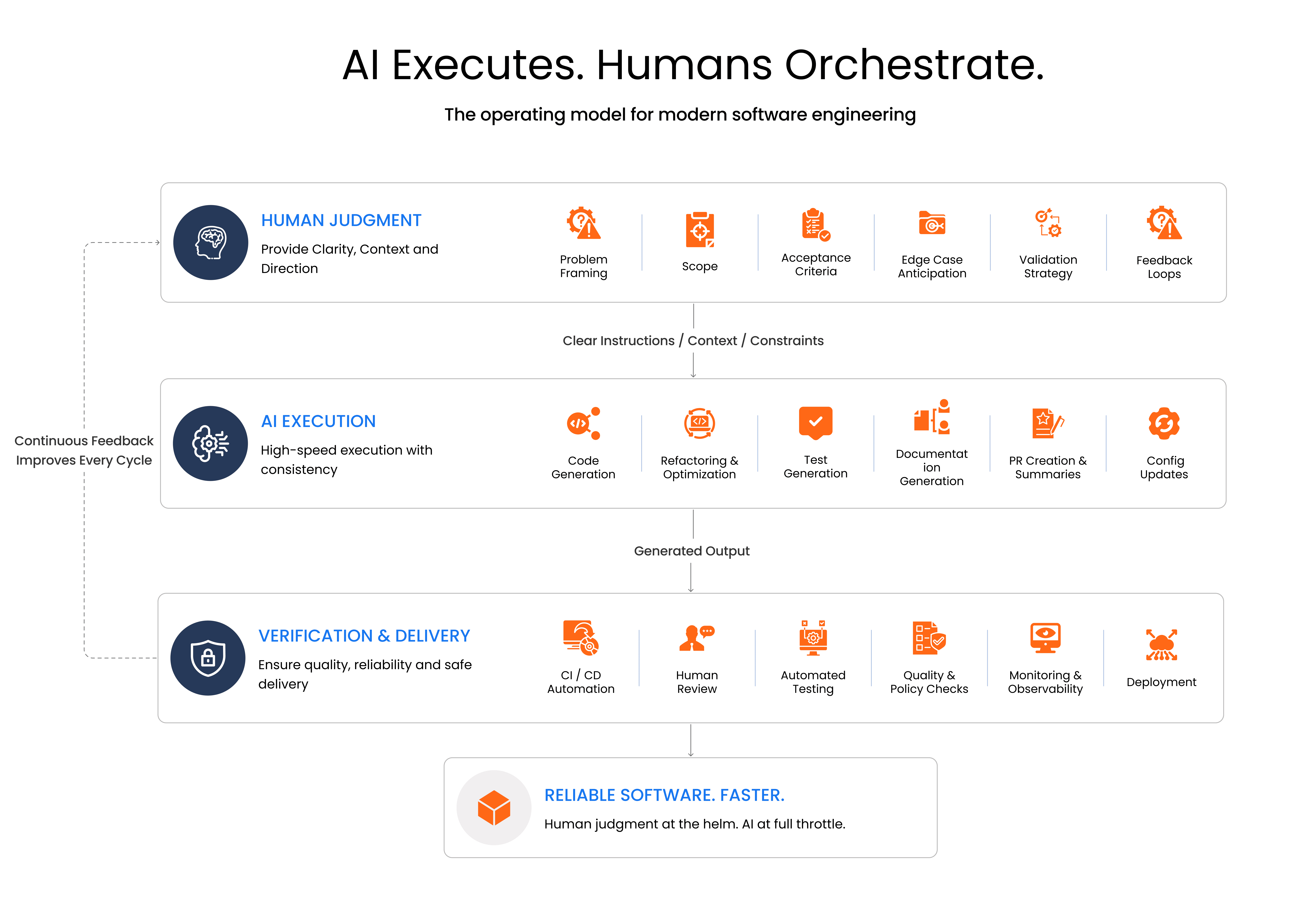
Fig: AI Executes. Humans Orchestrate.
Conclusion:
The move from SDLC to ADLC is less about replacing engineers and more about redefining where engineering value comes from. AI is already taking over large portions of repetitive execution across coding, testing, reviews, and deployment workflows, which means the differentiator for modern teams is no longer raw implementation speed. The organizations that succeed will be the ones that build strong operational systems around AI clear workflows, reliable validation layers, disciplined engineering practices, and thoughtful human oversight. In the ADLC era, the most valuable engineers will not simply be the people who can ship code fastest, but the ones who can design systems, define direction, and orchestrate intelligent execution at scale.