
Engineering at the Speed of Trust: Inside a DevOps Model Built for Airline Reliability
Engineering at the Speed of Trust: Inside a DevOps Model Built for Airline Reliability
Durgesh Sahoo - Senior Solution Architect
Read: 5 min
Introduction
Airlines cannot afford unreliable systems. Booking engines, loyalty platforms, check-in flows, disruption communications, crew tools, and operational applications all sit inside a high-pressure environment where delays ripple quickly. A failed release is not just an engineering issue. It can affect revenue, customer experience, airport operations, partner integrations, and brand trust.
That is why airline DevOps has to meet a higher standard. Speed matters, but speed alone is not enough. Every release must be safe enough to trust, traceable enough to govern, and repeatable enough to scale.
This is the idea behind engineering at the speed of trust. For airline platforms, DevOps is not simply a way to automate deployments. It is an operating discipline that connects engineering velocity with release confidence, infrastructure consistency, customer onboarding speed, and long-term platform reliability.
At Zapcom, this model is built around a practical belief: teams should be able to ship quickly without wondering whether the release path, environment configuration, or deployment process will hold under pressure.
The Trust Problem Behind Every Airline Release
Airline technology environments are complex by nature. Applications move through multiple validation stages. Configurations differ across environments. Integrations must behave consistently. Customer-specific setup needs to be handled carefully. Engineering teams need autonomy to move quickly, while delivery and operations leaders need confidence that every change is controlled.
This creates a familiar tension: the business wants faster delivery, but the platform cannot tolerate careless releases.
A trust-based DevOps model resolves that tension by making the release process visible, governed, and repeatable. It gives teams a shared path for how code moves from commit to production, how environments are provisioned, how artifacts are packaged, and how quality checks are applied before customer impact.
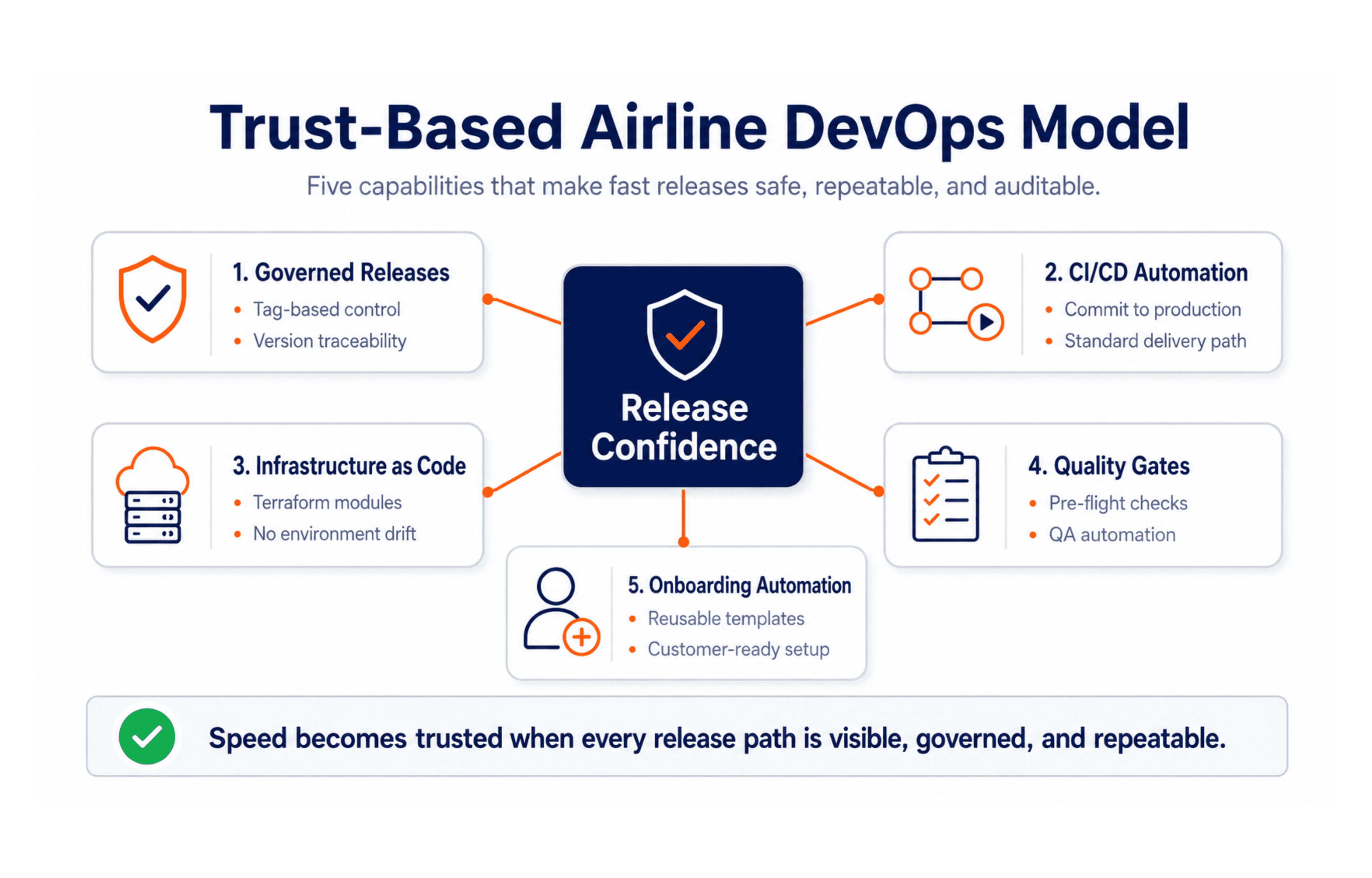
The model depends on five core capabilities:
Governed release control
Automated environment promotion
Infrastructure repeatability
Quality gates before production
Self-service engineering workflows
Together, these capabilities turn DevOps from a tooling function into a reliability system for airline digital transformation.
From Commit to Production: A Governed CI/CD Path
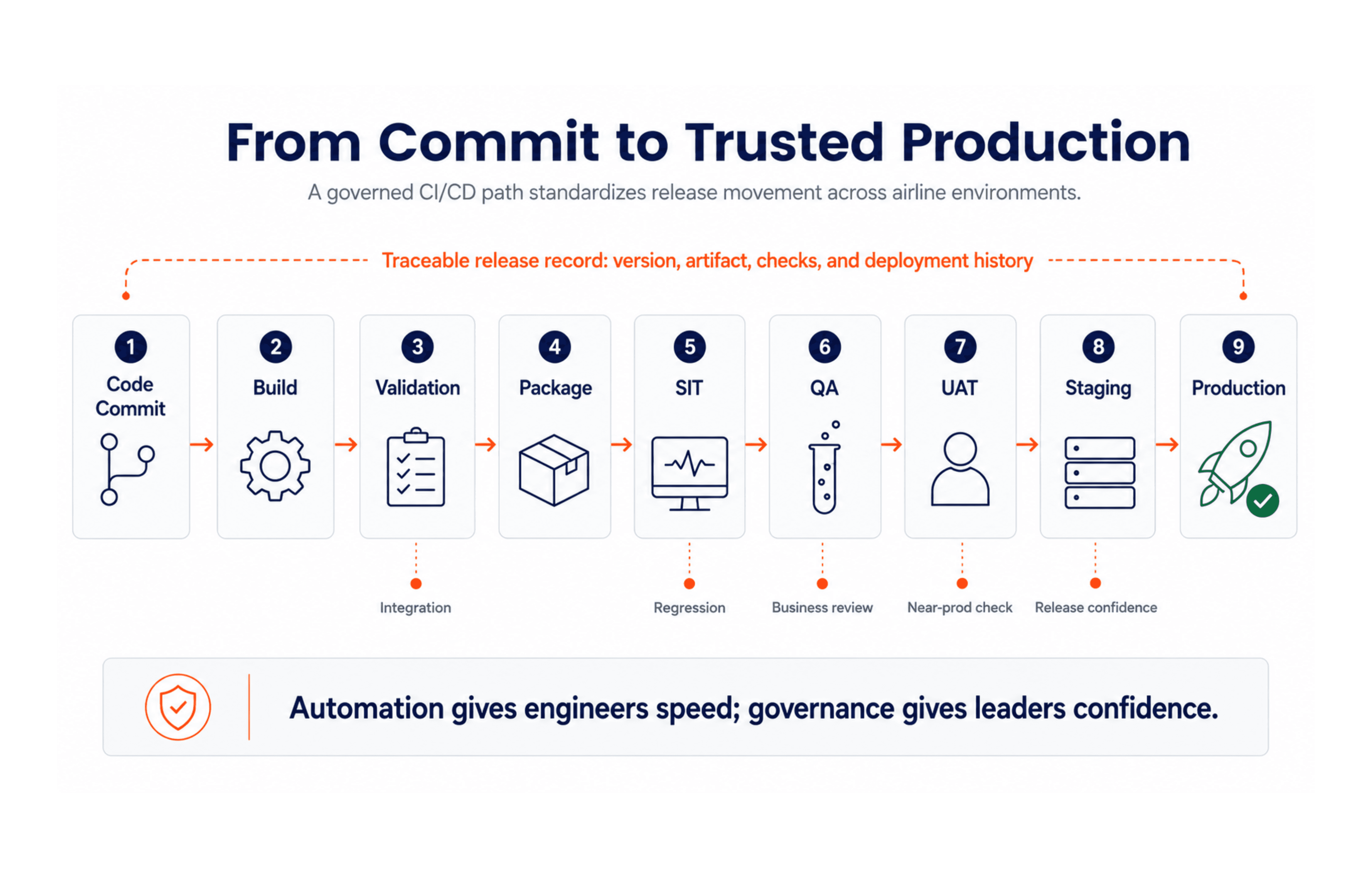
A reliable release model starts with a consistent path from code to production. Fully automated GitLab CI/CD pipelines orchestrate the journey from build and validation to packaging and deployment. Instead of every team maintaining its own release habits, the pipeline becomes a shared delivery standard.
For airline platforms, this consistency matters. Releases often need to move across SIT, QA, UAT, Staging, and Production, with each environment serving a different purpose in the validation lifecycle. SIT confirms early integration behavior. QA catches functional and regression issues. UAT supports business validation. Staging gives teams a near-production checkpoint. Production demands the highest level of confidence.
A strong pipeline does more than move code between those stages. It creates a record of what happened, when it happened, which version moved forward, and which checks were completed along the way.
This is where airline CI/CD pipelines become more than automation. They become an operational control layer. Engineers gain speed because repetitive steps are automated. Delivery leaders gain confidence because the process is standardized. Platform teams gain reliability because deployments are no longer dependent on manual coordination.
Release Governance Makes Every Deployment Deliberate
The most dangerous release is the one nobody can fully explain. In a fast-moving engineering environment, uncertainty around versioning, build lineage, or deployment history can create avoidable risk.
That is why governed releases are central to this DevOps model. A strict one-tag-one-build policy ensures that every production release maps cleanly to a specific source state. Semantic versioning enforcement makes release intent easier to understand. Automated version checks prevent accidental mismatches. Pre-flight validations catch readiness issues before the release advances.
The result is a release process where deployments are deliberate rather than accidental.
This matters deeply in airline environments because operational trust depends on traceability. If an issue appears after a release, teams need to know exactly what changed, which artifact was deployed, what configuration was used, and which validation steps passed. Without that traceability, incident response slows down and confidence erodes.
Governed release control also supports data security and compliance by making change history easier to review and audit. It does not replace broader security practices, but it gives engineering and operations teams a stronger foundation for accountability.
Infrastructure as Code: Scaling Without Environment Drift
Even the best release pipeline will struggle if environments are inconsistent. Manual provisioning creates drift over time. One environment gets a configuration change that another does not. A dependency is updated in one place and missed somewhere else. What works in QA behaves differently in Staging. Production readiness becomes harder to prove.
Infrastructure as Code solves this by making infrastructure versioned, repeatable, and reviewable.
Standardized Terraform modules for AWS resources such as EC2, Lambda, and supporting cloud components allow teams to provision infrastructure predictably across environments. Dedicated infrastructure repositories can manage GitLab runners, application resources, deployment dependencies, and environment-specific configuration in a controlled way.
This is especially important for cloud enablement services in airline platforms, where scalability and consistency have to grow together. As the customer base expands, infrastructure cannot depend on tribal knowledge or manual setup. It has to be codified, tested, and reusable.
Infrastructure as Code also strengthens cloud native application modernization because it aligns application delivery with platform scalability. Teams can evolve applications and environments together, reducing friction between software change and infrastructure readiness.
The Platform Stack Behind Trusted Airline DevOps
A trust-based DevOps model depends on more than one tool. It requires a connected platform stack where source control, pipeline orchestration, infrastructure provisioning, artifact management, deployment configuration, and quality validation work together.
In this model, GitLab CI/CD provides the orchestration layer for build, validation, packaging, and deployment. Terraform manages infrastructure as code, helping teams provision AWS resources such as EC2, Lambda, GitLab runners, and core application infrastructure in a repeatable way.
Artifact management is equally important. Deployable archives, version-controlled configuration packages, and release artifacts can be generated automatically and published to repositories and storage systems such as Artifactory, JFrog, and S3. This gives teams a reliable way to distribute the right version of the right package to the right environment.
Configuration-driven controls make the model flexible without weakening governance. Pipeline variables such as application, environment, log level, and run mode allow engineers to run a single manual stage or trigger a full end-to-end deployment. Pre-flight checks, repository validation, and integrated QA automation help confirm readiness before changes reach customer-facing environments.
The strength of this platform stack is not simply that each tool performs a function. It is that the tools work as a system. Source, build, artifact, infrastructure, configuration, and validation all become part of one controlled release path.
Customer Onboarding as a DevOps Capability
One of the clearest signs of DevOps maturity is how quickly and safely a platform can onboard a new customer.
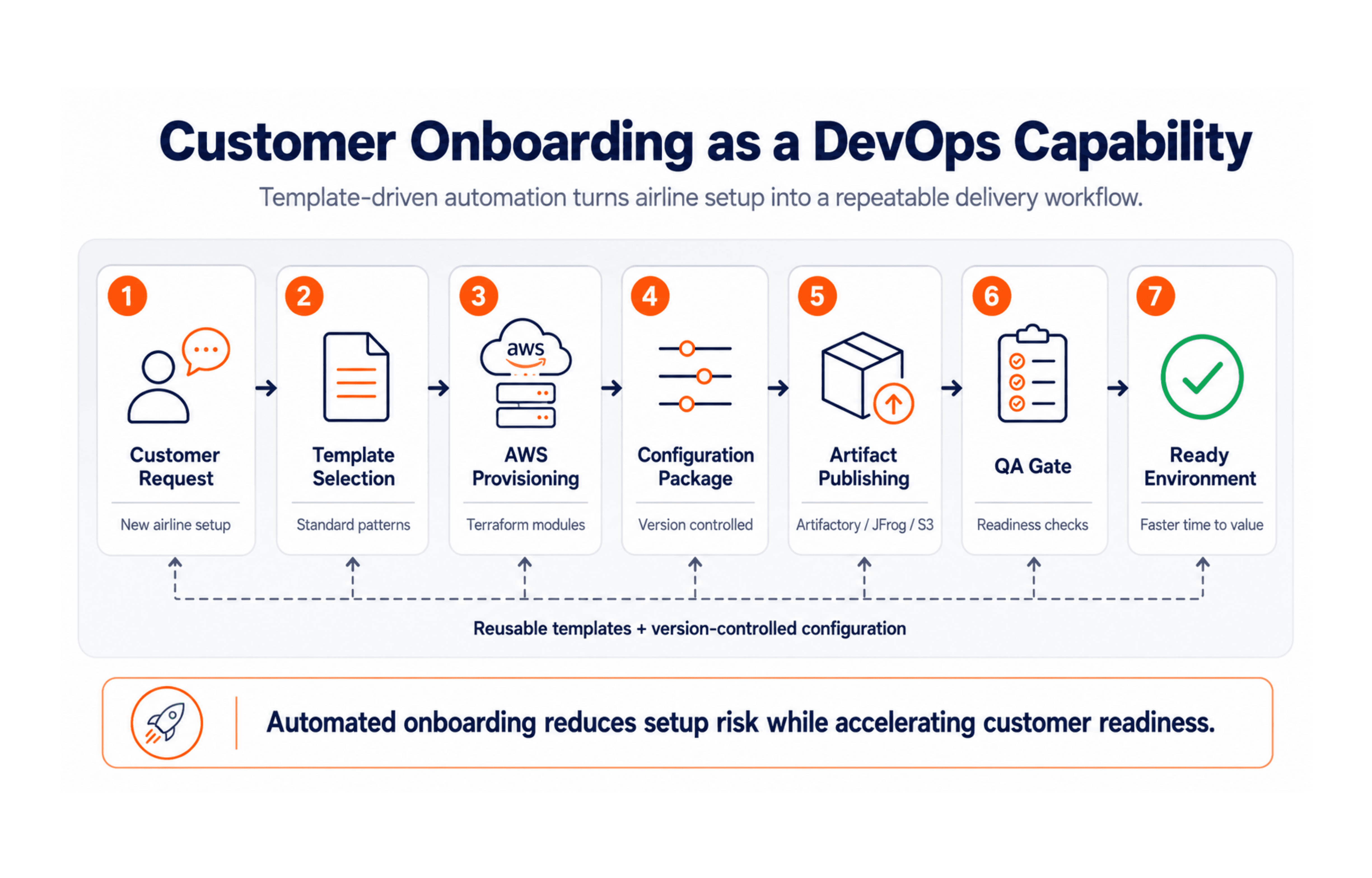
In airline technology, onboarding is rarely trivial. New airline customers may require environment setup, application configuration, artifact packaging, integration preparation, access controls, validation steps, and operational readiness checks. When these tasks are handled manually, the process becomes slow and error-prone. Each setup depends too heavily on individual knowledge.
By automating onboarding, the platform turns a delivery bottleneck into a repeatable capability.
Purpose-built templates and automation scripts allow new airline customers to be spun up quickly and consistently. Configuration packages can be version controlled. Deployable archives can be generated automatically. Artifacts can be published to systems such as Artifactory, JFrog, and S3. QA gates can be built into the process instead of treated as a late-stage checkpoint.
This is where intelligent automation solutions create practical business value. Automation does not only reduce engineering effort. It improves onboarding quality, shortens time to value, and gives customer-facing teams more confidence in delivery timelines.
Built-In Quality Gates Without Slowing Delivery
Many organizations treat quality gates as a drag on speed. In mature DevOps environments, the opposite is true. Quality gates reduce rework, prevent avoidable incidents, and help teams move faster because they are not constantly recovering from preventable failures.
Repository validation, pre-flight checks, integrated QA automation, artifact verification, and environment-specific controls all help catch issues before they reach customers. The goal is not to add bureaucracy. The goal is to shift risk detection earlier in the release lifecycle.
Flexible, self-service pipelines also matter here. Engineers need controlled ways to run a single manual stage, trigger an end-to-end deployment, adjust log levels, choose target environments, or run specific modes based on the release need. Configurable variables for application, environment, log level, and run mode give teams precision without breaking governance.
This balance is important. A DevOps platform that is too rigid slows teams down. A platform with no guardrails creates risk. The stronger model gives engineers autonomy inside a trusted delivery framework.
The Business Impact: Faster Releases, Lower Risk, Scalable Growth
The value of airline DevOps is not limited to engineering productivity. It shows up in business outcomes.
When releases are automated and governed, teams can ship more frequently without increasing deployment anxiety. When environments are provisioned through Terraform, infrastructure grows without manual drift. When artifacts and configuration packages are generated consistently, teams spend less time resolving packaging errors. When onboarding is template-driven, new airline customers can go live faster and with fewer setup issues.
The impact is practical:
Engineering teams gain a faster and more consistent release path.
Delivery leaders gain better predictability across customer programs.
Airline customers gain confidence that changes are controlled and traceable.
Platform teams gain a scalable foundation for future growth.
This is the kind of DevOps capability that supports long-term airline reliability. It connects speed with governance, automation with accountability, and cloud scale with operational discipline.
The Trust Problem Behind Every Airline Release
Airline technology environments are complex by nature. Applications move through multiple validation stages. Configurations differ across environments. Integrations must behave consistently. Customer-specific setup needs to be handled carefully. Engineering teams need autonomy to move quickly, while delivery and operations leaders need confidence that every change is controlled.
This creates a familiar tension: the business wants faster delivery, but the platform cannot tolerate careless releases.
A trust-based DevOps model resolves that tension by making the release process visible, governed, and repeatable. It gives teams a shared path for how code moves from commit to production, how environments are provisioned, how artifacts are packaged, and how quality checks are applied before customer impact.
The model depends on five core capabilities:
Governed release control
Automated environment promotion
Infrastructure repeatability
Quality gates before production
Self-service engineering workflows
Together, these capabilities turn DevOps from a tooling function into a reliability system for airline digital transformation.
From Commit to Production: A Governed CI/CD Path
A reliable release model starts with a consistent path from code to production. Fully automated GitLab CI/CD pipelines orchestrate the journey from build and validation to packaging and deployment. Instead of every team maintaining its own release habits, the pipeline becomes a shared delivery standard.
For airline platforms, this consistency matters. Releases often need to move across SIT, QA, UAT, Staging, and Production, with each environment serving a different purpose in the validation lifecycle. SIT confirms early integration behavior. QA catches functional and regression issues. UAT supports business validation. Staging gives teams a near-production checkpoint. Production demands the highest level of confidence.
A strong pipeline does more than move code between those stages. It creates a record of what happened, when it happened, which version moved forward, and which checks were completed along the way.
This is where airline CI/CD pipelines become more than automation. They become an operational control layer. Engineers gain speed because repetitive steps are automated. Delivery leaders gain confidence because the process is standardized. Platform teams gain reliability because deployments are no longer dependent on manual coordination.
Release Governance Makes Every Deployment Deliberate
The most dangerous release is the one nobody can fully explain. In a fast-moving engineering environment, uncertainty around versioning, build lineage, or deployment history can create avoidable risk.
That is why governed releases are central to this DevOps model. A strict one-tag-one-build policy ensures that every production release maps cleanly to a specific source state. Semantic versioning enforcement makes release intent easier to understand. Automated version checks prevent accidental mismatches. Pre-flight validations catch readiness issues before the release advances.
The result is a release process where deployments are deliberate rather than accidental.
This matters deeply in airline environments because operational trust depends on traceability. If an issue appears after a release, teams need to know exactly what changed, which artifact was deployed, what configuration was used, and which validation steps passed. Without that traceability, incident response slows down and confidence erodes.
Governed release control also supports data security and compliance by making change history easier to review and audit. It does not replace broader security practices, but it gives engineering and operations teams a stronger foundation for accountability.
Infrastructure as Code: Scaling Without Environment Drift
Even the best release pipeline will struggle if environments are inconsistent. Manual provisioning creates drift over time. One environment gets a configuration change that another does not. A dependency is updated in one place and missed somewhere else. What works in QA behaves differently in Staging. Production readiness becomes harder to prove.
Infrastructure as Code solves this by making infrastructure versioned, repeatable, and reviewable.
Standardized Terraform modules for AWS resources such as EC2, Lambda, and supporting cloud components allow teams to provision infrastructure predictably across environments. Dedicated infrastructure repositories can manage GitLab runners, application resources, deployment dependencies, and environment-specific configuration in a controlled way.
This is especially important for cloud enablement services in airline platforms, where scalability and consistency have to grow together. As the customer base expands, infrastructure cannot depend on tribal knowledge or manual setup. It has to be codified, tested, and reusable.
Infrastructure as Code also strengthens cloud native application modernization because it aligns application delivery with platform scalability. Teams can evolve applications and environments together, reducing friction between software change and infrastructure readiness.
The Platform Stack Behind Trusted Airline DevOps
A trust-based DevOps model depends on more than one tool. It requires a connected platform stack where source control, pipeline orchestration, infrastructure provisioning, artifact management, deployment configuration, and quality validation work together.
In this model, GitLab CI/CD provides the orchestration layer for build, validation, packaging, and deployment. Terraform manages infrastructure as code, helping teams provision AWS resources such as EC2, Lambda, GitLab runners, and core application infrastructure in a repeatable way.
Artifact management is equally important. Deployable archives, version-controlled configuration packages, and release artifacts can be generated automatically and published to repositories and storage systems such as Artifactory, JFrog, and S3. This gives teams a reliable way to distribute the right version of the right package to the right environment.
Configuration-driven controls make the model flexible without weakening governance. Pipeline variables such as application, environment, log level, and run mode allow engineers to run a single manual stage or trigger a full end-to-end deployment. Pre-flight checks, repository validation, and integrated QA automation help confirm readiness before changes reach customer-facing environments.
The strength of this platform stack is not simply that each tool performs a function. It is that the tools work as a system. Source, build, artifact, infrastructure, configuration, and validation all become part of one controlled release path.
Customer Onboarding as a DevOps Capability
One of the clearest signs of DevOps maturity is how quickly and safely a platform can onboard a new customer.
In airline technology, onboarding is rarely trivial. New airline customers may require environment setup, application configuration, artifact packaging, integration preparation, access controls, validation steps, and operational readiness checks. When these tasks are handled manually, the process becomes slow and error-prone. Each setup depends too heavily on individual knowledge.
By automating onboarding, the platform turns a delivery bottleneck into a repeatable capability.
Purpose-built templates and automation scripts allow new airline customers to be spun up quickly and consistently. Configuration packages can be version controlled. Deployable archives can be generated automatically. Artifacts can be published to systems such as Artifactory, JFrog, and S3. QA gates can be built into the process instead of treated as a late-stage checkpoint.
This is where intelligent automation solutions create practical business value. Automation does not only reduce engineering effort. It improves onboarding quality, shortens time to value, and gives customer-facing teams more confidence in delivery timelines.
Built-In Quality Gates Without Slowing Delivery
Many organizations treat quality gates as a drag on speed. In mature DevOps environments, the opposite is true. Quality gates reduce rework, prevent avoidable incidents, and help teams move faster because they are not constantly recovering from preventable failures.
Repository validation, pre-flight checks, integrated QA automation, artifact verification, and environment-specific controls all help catch issues before they reach customers. The goal is not to add bureaucracy. The goal is to shift risk detection earlier in the release lifecycle.
Flexible, self-service pipelines also matter here. Engineers need controlled ways to run a single manual stage, trigger an end-to-end deployment, adjust log levels, choose target environments, or run specific modes based on the release need. Configurable variables for application, environment, log level, and run mode give teams precision without breaking governance.
This balance is important. A DevOps platform that is too rigid slows teams down. A platform with no guardrails creates risk. The stronger model gives engineers autonomy inside a trusted delivery framework.
The Business Impact: Faster Releases, Lower Risk, Scalable Growth
The value of airline DevOps is not limited to engineering productivity. It shows up in business outcomes.
When releases are automated and governed, teams can ship more frequently without increasing deployment anxiety. When environments are provisioned through Terraform, infrastructure grows without manual drift. When artifacts and configuration packages are generated consistently, teams spend less time resolving packaging errors. When onboarding is template-driven, new airline customers can go live faster and with fewer setup issues.
The impact is practical:
Engineering teams gain a faster and more consistent release path.
Delivery leaders gain better predictability across customer programs.
Airline customers gain confidence that changes are controlled and traceable.
Platform teams gain a scalable foundation for future growth.
This is the kind of DevOps capability that supports long-term airline reliability. It connects speed with governance, automation with accountability, and cloud scale with operational discipline.

Fig: Platform automation enables trusted DevOps practices.
Conclusion
Airline platforms operate in an environment where trust is earned release by release. Customers expect digital experiences to work. Operations teams expect systems to stay available. Engineering teams need to move quickly without introducing unnecessary risk.
That requires a DevOps model built for more than speed.
With automated GitLab CI/CD pipelines, tag-based governed releases, semantic versioning, multi-environment orchestration, Terraform-based Infrastructure as Code, automated customer onboarding, artifact management, and built-in quality gates, DevOps becomes a discipline for reliable scale.
For airline technology leaders looking to modernize release operations, Zapcom helps build scalable DevOps, cloud, automation, and platform engineering capabilities that improve reliability, accelerate onboarding, and support always-on digital operations.
Engineering at the speed of trust means every release has a clear path, every deployment has a record, every environment can be reproduced, and every customer setup can be repeated with confidence.
Join our newsletter.
Smart reads, bold ideas and what’s next sent to you.
Resources
Join our newsletter.
Smart reads, bold ideas and what’s next sent to you.
Resources
Join our newsletter.
Smart reads, bold ideas and what’s next sent to you.
Resources