
From Traditional QA to AI Quality Engineering: The New Era of Banking and Payment Testing
From Traditional QA to AI Quality Engineering: The New Era of Banking and Payment Testing
Ramachandran Periyasamypandian, Sr. SDET
Read: 10 min
Introduction
A banking platform can pass thousands of automated tests and still carry a production risk that matters more than the test report suggests.
A payment flow may work as expected in a controlled scenario, yet fail when a third-party API slows down. A fraud model may perform well against known patterns but behave differently when customer behavior changes. A compliance rule may be updated before the regression suite has even been revised.
For decades, banking quality assurance was built around deterministic systems. Teams focused on validating predefined business rules, transaction accuracy, regulatory compliance, and regression stability. Success was measured through execution metrics such as test case completion, automation coverage, defect closure rates, and release readiness.
Those metrics still matter. But modern banking has changed the question Quality Engineering teams need to answer.
Can financial institutions confidently release AI-enabled banking platforms without compromising security, compliance, customer trust, or operational resilience?
Digital payments, real-time settlements, embedded finance, open banking APIs, fraud detection models, AI-powered customer interactions, and cloud-native architectures have fundamentally changed how financial platforms are built and operated.
Traditional automation alone cannot provide sufficient release confidence in this environment.
Quality Engineering is evolving toward an AI-assisted model where intelligent systems help teams predict risk, optimize testing, accelerate validation, and improve production confidence while keeping human expertise at the center of critical decisions.
Why Traditional Banking QA Is No Longer Enough
Enterprise banking systems no longer operate as isolated applications.
A single customer transaction can move across interconnected services, payment gateways, fraud engines, regulatory controls, cloud infrastructure, third-party APIs, and real-time analytics platforms. Testing every workflow through traditional scripted approaches becomes increasingly difficult as these dependencies grow.
Modern banking environments introduce a different level of complexity:
Distributed microservices
Real-time payment processing
Event-driven architectures
Continuous software delivery
API-first integrations
Dynamic fraud detection models
Rapidly changing regulatory requirements
A regression suite may report a 98% success rate while critical production risks remain hidden beneath execution metrics.
Consider what can happen in production:
An AI fraud model behaves differently with unseen customer behavior.
Payment orchestration fails across multiple providers.
Third-party API latency affects settlement timelines.
Model drift impacts credit decision accuracy.
Compliance rules change faster than regression cycles.
Execution status alone is no longer a reliable indicator of production readiness.
The challenge is not that traditional automation has become irrelevant. It is that banking systems now require QA strategies that can understand risk, change, dependencies, and behavior, not just whether an individual test passed.
The Rise of AI Quality Engineering in Banking
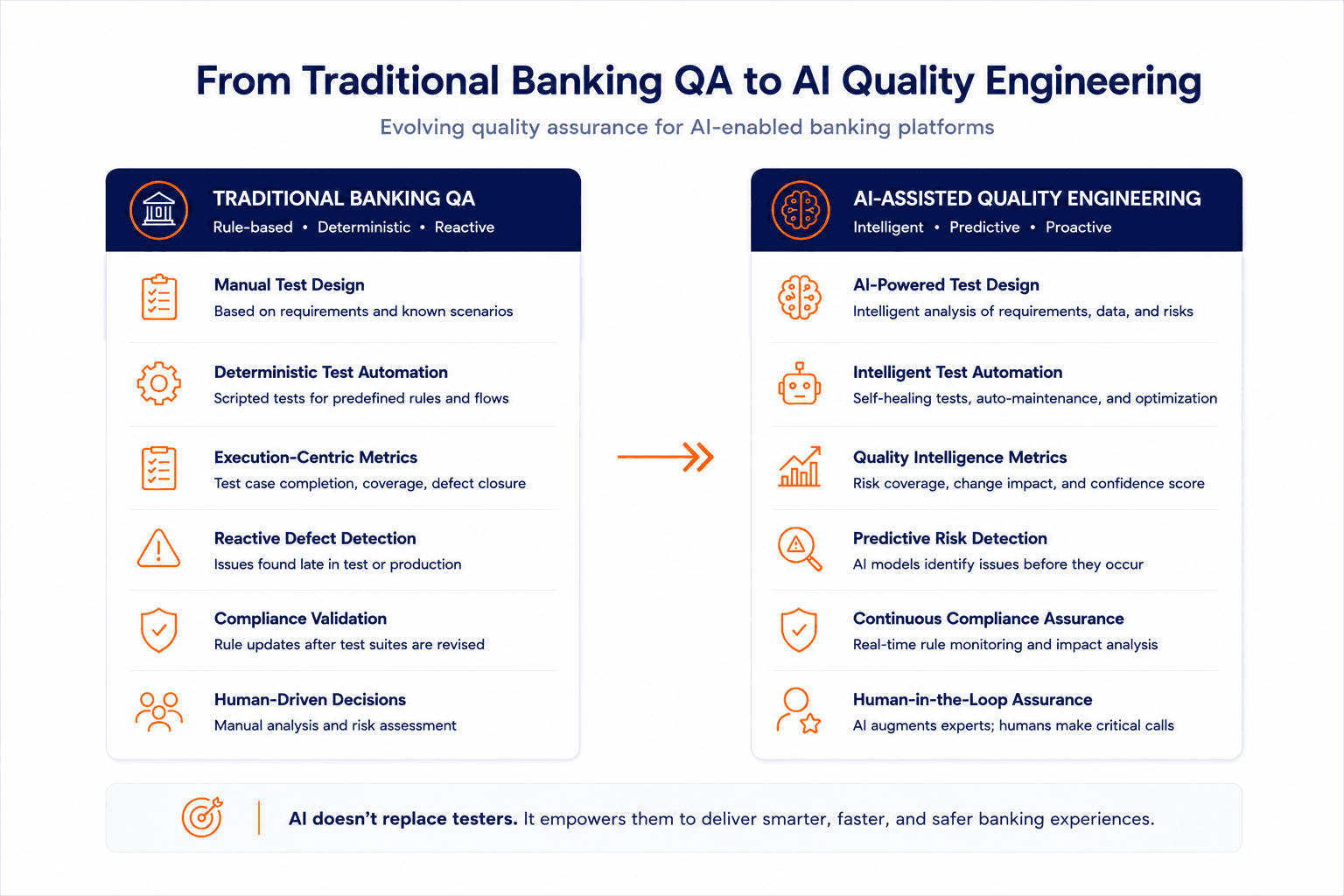
Artificial Intelligence is not replacing Quality Engineers. It is changing how quality is planned, validated, and continuously improved across the software delivery lifecycle.
Modern AI-powered Quality Engineering introduces intelligence across testing activities.
Instead of manually creating thousands of test cases, AI can analyze requirements, identify critical workflows, recommend missing scenarios, and prioritize testing based on production risk. Instead of executing every regression suite, AI can help identify the smallest set of high-risk tests capable of delivering meaningful release confidence. Instead of manually analyzing failed executions, AI can accelerate defect clustering, identify recurring failure patterns, and assist engineers with root-cause analysis.
This represents a broader shift:
Quality Engineering is moving from execution-focused validation toward intelligent risk management.
How AI Is Transforming Banking and Payment Testing
AI is creating new possibilities across multiple quality engineering functions.
Intelligent Requirement Analysis
Testing risk often begins before the first test case is written.
AI can help teams identify ambiguous requirements, missing acceptance criteria, hidden dependencies, and business scenarios that may otherwise be overlooked.
In banking, this can be particularly valuable for workflows involving transaction rules, payment states, customer eligibility, regulatory controls, and exception handling.
The objective is not for AI to define the requirement.
It is to help Quality Engineers identify gaps earlier, when they are easier and less expensive to address.
Risk-Based Test Generation
Traditional automation can generate large numbers of test cases. The harder question is knowing which scenarios deserve the most attention. AI-assisted Quality Engineering can recommend scenarios based on operational and business impact rather than simply increasing test volume.
For banking and payment systems, these may include:
Duplicate payments
Transaction reversals
Settlement failures
Payment retries
Authentication edge cases
Fraud detection exceptions
High-value transaction validation
The conversation shifts from:
“How many tests did we automate?”
to:
“Did we validate the workflows most likely to create business impact?”
Smarter API Testing
Modern banking depends heavily on APIs. They connect customer applications, payment services, fraud engines, internal platforms, and third-party providers. As the number of dependencies increases, API quality becomes central to end-to-end transaction reliability.
AI can assist by:
Generating realistic payload combinations
Identifying negative scenarios
Validating API contracts
Detecting unusual response patterns
Recommending additional edge cases
For financial platforms, this becomes particularly important when a single transaction crosses several APIs and external services before completion.
Intelligent Regression Optimization
Running the complete regression suite after every change does not always provide the best balance between speed and confidence.
AI can analyze application changes, historical failures, dependency mapping, and production incidents to predict which regression suites are most likely to provide meaningful coverage for a specific release.
The goal is not simply to run fewer tests.
The goal is to focus testing where a change is most likely to introduce production risk.
Why Payment Testing Requires a Different Quality Strategy
Payment platforms operate with an extremely low tolerance for failure.
A single production defect can result in duplicate payments, failed settlements, delayed fund transfers, reconciliation mismatches, regulatory violations, financial losses, or reputational damage.
The payment ecosystem itself is highly distributed.
A transaction may interact with:
UPI
Card networks
Wallets
Open Banking APIs
SWIFT
NEFT
RTGS
Real-time payment systems
Each transaction therefore becomes a chain of interconnected validations.
AI can help teams simulate complex payment journeys, generate synthetic financial data, identify unusual transaction behavior, and validate critical business paths more efficiently than traditional scripted approaches.
For example, an end-to-end payment validation strategy can examine whether a transaction is correctly authenticated, evaluated for fraud, processed through the appropriate payment service, settled successfully, and reflected accurately downstream.
That broader view matters because a payment can appear successful at one stage while failing later in the transaction lifecycle.
The Metrics That Matter More Than Automation Coverage
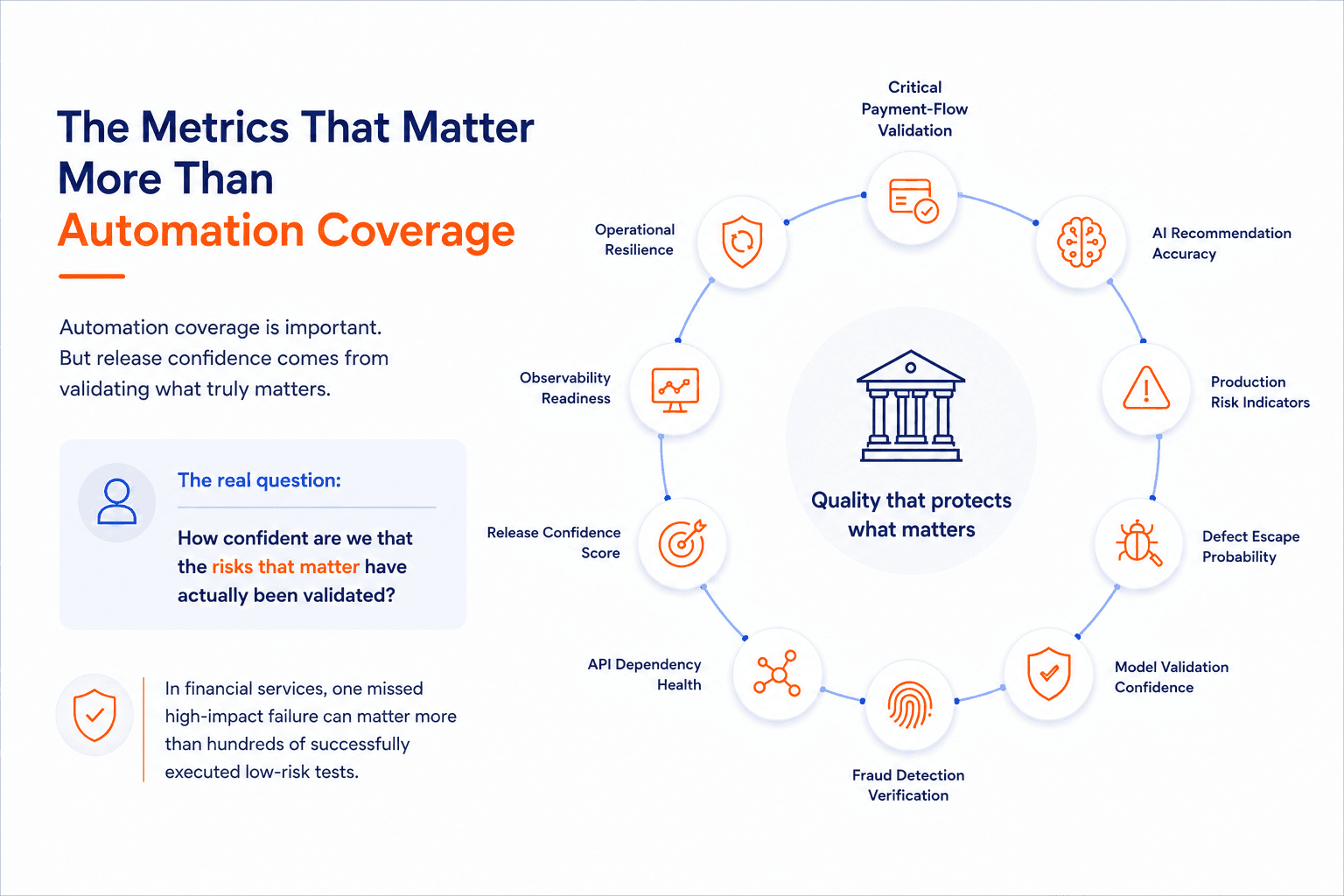
Automation coverage remains an important engineering metric.
But it does not, by itself, represent release confidence.
As AI becomes part of banking applications, Quality Engineering teams need a broader view of quality:
Critical payment-flow validation
AI recommendation accuracy
Production risk indicators
Defect escape probability
Model validation confidence
Fraud detection verification
API dependency health
Release confidence score
Observability readiness
Operational resilience
These metrics help answer a more useful question:
How confident are we that the risks that matter have actually been validated?
That distinction is critical in financial services. One missed high-impact failure can matter more than hundreds of successfully executed low-risk tests.
Human Expertise Remains the Ultimate Quality Gate
Despite rapid AI adoption, banking quality cannot become fully autonomous.
Financial platforms operate within regulatory, security and compliance constraints that still require experienced engineering judgment.
Quality Engineers need to understand:
Banking regulations
Customer trust
Financial risk
Security controls
Compliance obligations
Business priorities
AI can recommend.
It can identify patterns.
It can prioritize regression.
It can analyze thousands of failures.
But engineers remain accountable for release decisions.
The strongest Quality Engineering teams combine artificial intelligence with domain expertise, governance, and engineering judgment.
That human layer becomes even more important as AI systems take on a larger role in fraud detection, customer interactions, decision support, and other financial workflows.
What Banking Organizations Need to Rethink
The transition to AI Quality Engineering is not simply a tooling upgrade. It requires organizations to rethink how quality is measured and managed across the delivery lifecycle.
Are we testing business risk or simply executing test cases?
Test prioritization should reflect transaction criticality, customer impact, regulatory exposure, and production history.
Can our QA strategy adapt as the application changes?
Testing needs to evolve as requirements, dependencies, models, APIs, and application behavior change.
Do our metrics represent release confidence?
Automation percentage can indicate execution progress, but it cannot fully explain production readiness.
Can AI-driven components be validated differently from deterministic software?
Fraud models, recommendation systems, AI assistants, and other intelligent components may require continuous evaluation rather than traditional pass/fail assertions.
Where must human accountability remain?
For high-impact financial workflows, AI should support engineering judgment rather than replace it.
Why Traditional Banking QA Is No Longer Enough
Enterprise banking systems no longer operate as isolated applications.
A single customer transaction can move across interconnected services, payment gateways, fraud engines, regulatory controls, cloud infrastructure, third-party APIs, and real-time analytics platforms. Testing every workflow through traditional scripted approaches becomes increasingly difficult as these dependencies grow.
Modern banking environments introduce a different level of complexity:
Distributed microservices
Real-time payment processing
Event-driven architectures
Continuous software delivery
API-first integrations
Dynamic fraud detection models
Rapidly changing regulatory requirements
A regression suite may report a 98% success rate while critical production risks remain hidden beneath execution metrics.
Consider what can happen in production:
An AI fraud model behaves differently with unseen customer behavior.
Payment orchestration fails across multiple providers.
Third-party API latency affects settlement timelines.
Model drift impacts credit decision accuracy.
Compliance rules change faster than regression cycles.
Execution status alone is no longer a reliable indicator of production readiness.
The challenge is not that traditional automation has become irrelevant. It is that banking systems now require QA strategies that can understand risk, change, dependencies, and behavior, not just whether an individual test passed.
The Rise of AI Quality Engineering in Banking
Artificial Intelligence is not replacing Quality Engineers. It is changing how quality is planned, validated, and continuously improved across the software delivery lifecycle.
Modern AI-powered Quality Engineering introduces intelligence across testing activities.
Instead of manually creating thousands of test cases, AI can analyze requirements, identify critical workflows, recommend missing scenarios, and prioritize testing based on production risk. Instead of executing every regression suite, AI can help identify the smallest set of high-risk tests capable of delivering meaningful release confidence. Instead of manually analyzing failed executions, AI can accelerate defect clustering, identify recurring failure patterns, and assist engineers with root-cause analysis.
This represents a broader shift:
Quality Engineering is moving from execution-focused validation toward intelligent risk management.
How AI Is Transforming Banking and Payment Testing
AI is creating new possibilities across multiple quality engineering functions.
Intelligent Requirement Analysis
Testing risk often begins before the first test case is written.
AI can help teams identify ambiguous requirements, missing acceptance criteria, hidden dependencies, and business scenarios that may otherwise be overlooked.
In banking, this can be particularly valuable for workflows involving transaction rules, payment states, customer eligibility, regulatory controls, and exception handling.
The objective is not for AI to define the requirement.
It is to help Quality Engineers identify gaps earlier, when they are easier and less expensive to address.
Risk-Based Test Generation
Traditional automation can generate large numbers of test cases. The harder question is knowing which scenarios deserve the most attention. AI-assisted Quality Engineering can recommend scenarios based on operational and business impact rather than simply increasing test volume.
For banking and payment systems, these may include:
Duplicate payments
Transaction reversals
Settlement failures
Payment retries
Authentication edge cases
Fraud detection exceptions
High-value transaction validation
The conversation shifts from:
“How many tests did we automate?”
to:
“Did we validate the workflows most likely to create business impact?”
Smarter API Testing
Modern banking depends heavily on APIs. They connect customer applications, payment services, fraud engines, internal platforms, and third-party providers. As the number of dependencies increases, API quality becomes central to end-to-end transaction reliability.
AI can assist by:
Generating realistic payload combinations
Identifying negative scenarios
Validating API contracts
Detecting unusual response patterns
Recommending additional edge cases
For financial platforms, this becomes particularly important when a single transaction crosses several APIs and external services before completion.
Intelligent Regression Optimization
Running the complete regression suite after every change does not always provide the best balance between speed and confidence.
AI can analyze application changes, historical failures, dependency mapping, and production incidents to predict which regression suites are most likely to provide meaningful coverage for a specific release.
The goal is not simply to run fewer tests.
The goal is to focus testing where a change is most likely to introduce production risk.
Why Payment Testing Requires a Different Quality Strategy
Payment platforms operate with an extremely low tolerance for failure.
A single production defect can result in duplicate payments, failed settlements, delayed fund transfers, reconciliation mismatches, regulatory violations, financial losses, or reputational damage.
The payment ecosystem itself is highly distributed.
A transaction may interact with:
UPI
Card networks
Wallets
Open Banking APIs
SWIFT
NEFT
RTGS
Real-time payment systems
Each transaction therefore becomes a chain of interconnected validations.
AI can help teams simulate complex payment journeys, generate synthetic financial data, identify unusual transaction behavior, and validate critical business paths more efficiently than traditional scripted approaches.
For example, an end-to-end payment validation strategy can examine whether a transaction is correctly authenticated, evaluated for fraud, processed through the appropriate payment service, settled successfully, and reflected accurately downstream.
That broader view matters because a payment can appear successful at one stage while failing later in the transaction lifecycle.
The Metrics That Matter More Than Automation Coverage
Automation coverage remains an important engineering metric.
But it does not, by itself, represent release confidence.
As AI becomes part of banking applications, Quality Engineering teams need a broader view of quality:
Critical payment-flow validation
AI recommendation accuracy
Production risk indicators
Defect escape probability
Model validation confidence
Fraud detection verification
API dependency health
Release confidence score
Observability readiness
Operational resilience
These metrics help answer a more useful question:
How confident are we that the risks that matter have actually been validated?
That distinction is critical in financial services. One missed high-impact failure can matter more than hundreds of successfully executed low-risk tests.
Human Expertise Remains the Ultimate Quality Gate
Despite rapid AI adoption, banking quality cannot become fully autonomous.
Financial platforms operate within regulatory, security and compliance constraints that still require experienced engineering judgment.
Quality Engineers need to understand:
Banking regulations
Customer trust
Financial risk
Security controls
Compliance obligations
Business priorities
AI can recommend.
It can identify patterns.
It can prioritize regression.
It can analyze thousands of failures.
But engineers remain accountable for release decisions.
The strongest Quality Engineering teams combine artificial intelligence with domain expertise, governance, and engineering judgment.
That human layer becomes even more important as AI systems take on a larger role in fraud detection, customer interactions, decision support, and other financial workflows.
What Banking Organizations Need to Rethink
The transition to AI Quality Engineering is not simply a tooling upgrade. It requires organizations to rethink how quality is measured and managed across the delivery lifecycle.
Are we testing business risk or simply executing test cases?
Test prioritization should reflect transaction criticality, customer impact, regulatory exposure, and production history.
Can our QA strategy adapt as the application changes?
Testing needs to evolve as requirements, dependencies, models, APIs, and application behavior change.
Do our metrics represent release confidence?
Automation percentage can indicate execution progress, but it cannot fully explain production readiness.
Can AI-driven components be validated differently from deterministic software?
Fraud models, recommendation systems, AI assistants, and other intelligent components may require continuous evaluation rather than traditional pass/fail assertions.
Where must human accountability remain?
For high-impact financial workflows, AI should support engineering judgment rather than replace it.

Conclusion
Banking Quality Engineering is moving beyond traditional test execution toward intelligent, risk-driven validation. As payment ecosystems become more distributed, AI-driven, and continuously changing, automation alone is no longer enough to establish release confidence.
AI can help teams identify higher-risk scenarios, optimize regression, analyze failures, validate APIs, and surface risks earlier in the delivery lifecycle. But in financial services, technology cannot replace engineering judgment.
The strongest quality strategies combine AI capabilities, banking domain expertise, governance, and human accountability. The goal is not to execute more tests.
It is to reduce production risk, strengthen release confidence, and deliver secure, resilient, and trusted financial platforms at scale. The question is no longer whether AI will become part of Banking Quality Engineering.
Join our newsletter.
Smart reads, bold ideas and what’s next sent to you.
Resources
Join our newsletter.
Smart reads, bold ideas and what’s next sent to you.
Resources
Join our newsletter.
Smart reads, bold ideas and what’s next sent to you.
Resources