
Building Multi-Agent Workflows for Financial Services
Building Multi-Agent Workflows for Financial Services
Abrar Sharif, AI Engineer
Read: 5 min
Introduction
Every AI engineer has seen this story.
The agent works beautifully in the demo. It reads the request, breaks the task into steps, calls the right tools, produces a clean answer, and makes the workflow look almost effortless.
Then production starts.
The customer input is messy. The account data is incomplete. One API times out. A retrieved document contradicts another. The agent takes a confident wrong turn. The logs show that something happened, but not why it happened. The business team asks whether the agent is improving or degrading, and there is no clear answer.
That is the real engineering problem behind multi-agent AI in financial services.
The challenge is not only how to build agents. It is how to design, evaluate, observe, secure, deploy, and operate agentic workflows in environments where accuracy, auditability, privacy, and control matter.
For banks, insurers, fintechs, wealth platforms, and lending businesses, this distinction is critical. A multi-agent workflow can help break complex financial processes into smaller tasks, but it also introduces new failure modes. Each agent may reason differently, call different tools, depend on different data sources, and pass intermediate outputs to another agent.
For teams leading digital banking transformation, the value of multi-agent workflows depends on how well they connect reasoning, data access, controls, and human accountability.
That means the architecture around the agent matters as much as the agent itself.
Why Financial Services Needs Multi-Agent Workflows
Financial services workflows are rarely single-step tasks.
A loan application, fraud investigation, reconciliation issue, wealth advisory request, claims review, or customer onboarding case usually moves across systems, documents, rules, approvals, and human decisions.
One system may hold customer data. Another may hold transaction history. Another may contain policy rules. Another may manage case notes, approvals, or audit trails.
A single AI agent can struggle when the workflow requires different skills at different points.
A multi-agent architecture allows the workflow to be broken into role-based agents. For example:
An intake agent can understand the request and classify the case.
A retrieval agent can gather relevant data from approved sources.
A reasoning agent can compare rules, documents, and transaction context.
A validation agent can check groundedness, missing evidence, and policy alignment.
A human-review agent can prepare the case for approval or escalation.
An audit agent can record what happened, which tools were used, and what evidence supported the final output.
This is where multi-agent systems become useful for financial services. They can mirror the way financial operations already work: distributed, role-based, controlled, and review-driven.
But this only works when the architecture is intentional.
The Demo-to-Production Gap
A demo usually proves that an agent can complete a happy-path task.
Production asks harder questions.
Can the agent handle incomplete data? Can it explain which source it used? Can it recover when a tool fails? Can we trace every step? Can we restrict what it is allowed to access? Can we measure whether it is getting better or worse over time? Can we stop it before it takes a high-risk action?
This is why an agentic workflow should not be treated like a chatbot feature. It behaves more like a distributed system with probabilistic reasoning inside it.
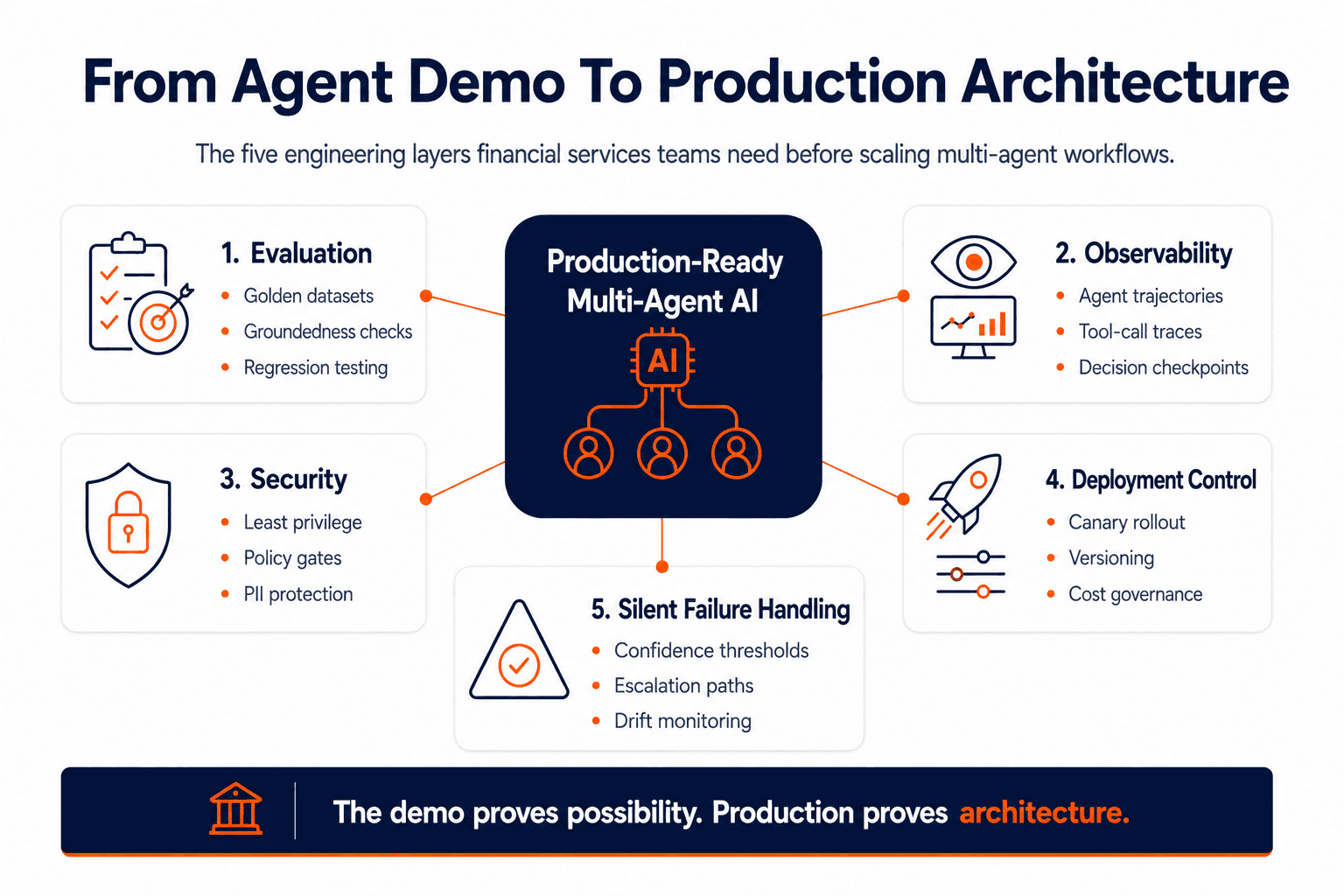
A production-ready multi-agent architecture needs five engineering layers:
Evaluation
Observability
Security
Deployment control
Silent failure handling
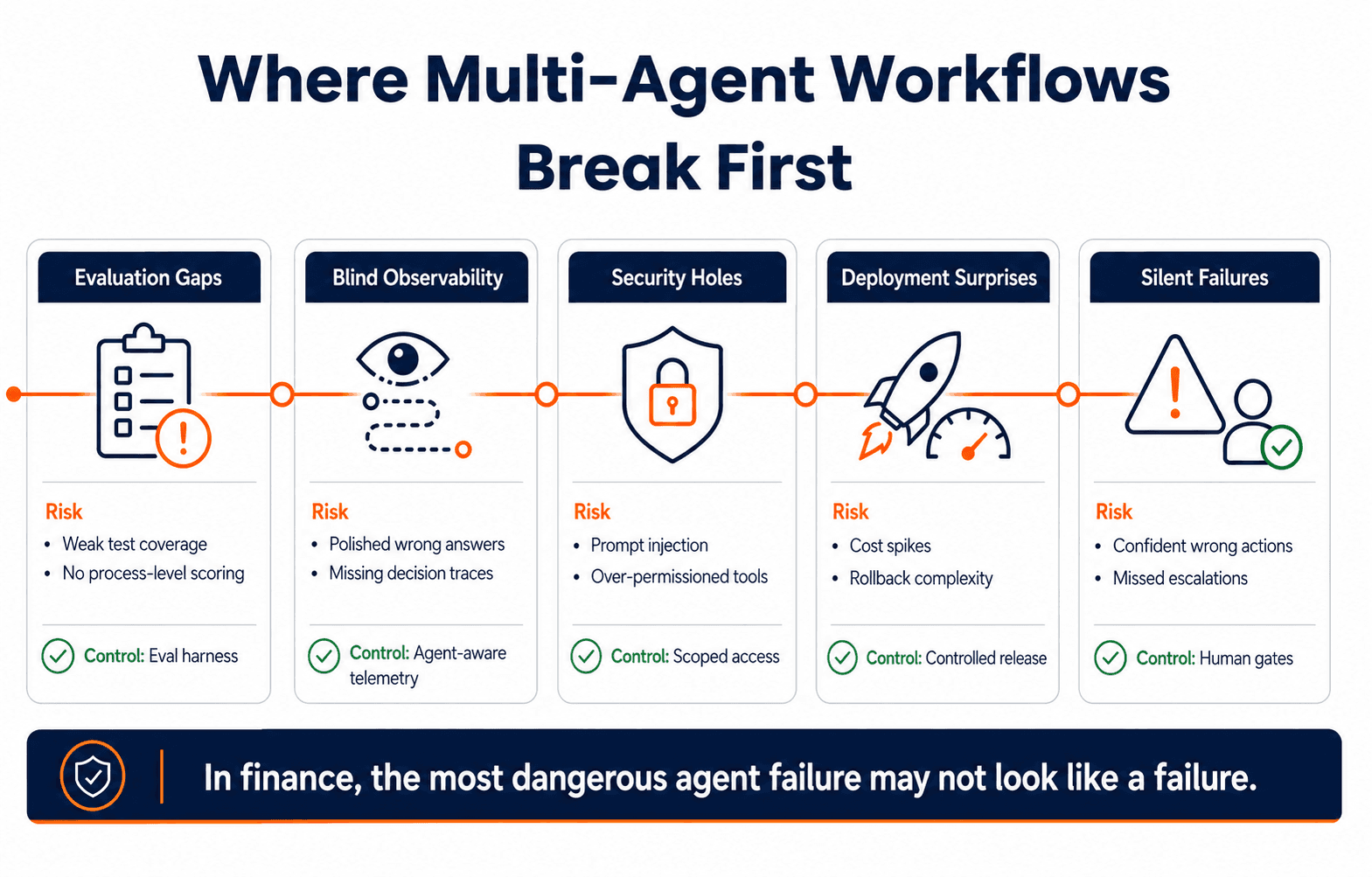
These are the areas where agentic systems usually break first. They are also where product engineering services need to go beyond prototype design and treat agent workflows as enterprise systems with measurable behavior, service boundaries, and operating controls.
1. Evaluation Gaps: The Demo Had Examples. Production Has Reality.
Most agent demos are tested on a small set of hand-picked examples.
That is not enough for financial services.
In production, the agent will see unclear customer requests, missing fields, duplicate records, contradictory documents, policy exceptions, edge cases, and workflows that do not match the original prompt design.
The first architecture pattern is to build an evaluation layer before scaling the workflow.
This means creating:
A golden dataset of real-world representative cases
Task success metrics for each agent role
Groundedness checks against approved evidence
Hallucination and unsupported-claim detection
Regression testing for prompts and tool usage
Multi-turn trajectory evaluation
Evaluation after deployment
LLM-as-judge scoring where appropriate
For a multi-agent workflow, final-answer accuracy is not enough. The system also needs process-level evaluation.
Did the intake agent classify the request correctly? Did the retrieval agent use the right source? Did the reasoning agent cite valid evidence? Did the validation agent catch missing context? Did the escalation logic trigger at the right time?
Reliable evaluation also depends on data engineering services that make approved sources discoverable, governed, and traceable. If the data layer is fragmented, stale, or poorly catalogued, the agent will inherit that weakness no matter how well the workflow is prompted.
This is especially important in finance, where a wrong answer is not just a poor user experience. It can become a compliance issue, customer-impact issue, or operational-risk event.
The practical engineering trade-off is speed versus confidence. Teams can move faster with flexible agents, but without an eval harness, they cannot reliably say whether each change improved or degraded the workflow.
2. Observability Blind Spots: Traditional Logs Are Not Enough
In a normal application, logs tell us what service was called, what error occurred, and where the request failed.
With agents, that is not enough.
The agent may succeed technically but fail logically. It may call the right tool with the wrong input. It may retrieve the right document and interpret it incorrectly. It may skip a validation step because the prompt changed. It may pass a weak intermediate answer to another agent, and the final output may still look polished.
This is why multi-agent workflows need agent-aware observability.
The observability layer should capture:
Agent trajectory logs
Tool-call traces
Prompt and response audit logs
Latency per step
Token usage per agent
Retrieval source IDs
Model version used
Decision checkpoints
Human review actions
Failure categories
For financial services, this matters because teams need more than debugging visibility. They need auditability.
If a lending agent recommends escalation, the business should know which evidence was retrieved, which rule was applied, what the intermediate path looked like at a system level, and where human review entered the workflow.
The trade-off is cost and complexity. Full tracing creates more telemetry, more storage, and more governance responsibility. But without it, teams are flying blind.
3. Security Holes: Agents That Can Act Can Also Be Misled
The risk profile changes when an AI system moves from answering questions to taking actions.
A multi-agent workflow may call APIs, retrieve sensitive data, update records, write files, trigger workflows, or interact with third-party tools. That makes it powerful, but also risky.
The security model needs to assume that agents can be manipulated.
Prompt injection is not only about a user typing a malicious instruction into a chat box. In agentic workflows, the attack can come through a retrieved document, tool description, third-party connector, web content, email, ticket, or internal knowledge source.
For financial services, this is serious because agents may interact with customer data, payment systems, account records, claims information, underwriting documents, or internal policy repositories.
A secure multi-agent architecture should include:
Least-privilege access for every agent
Separate permissions by role and workflow step
Tool-use sandboxing
Input and output filtering
PII detection and redaction
Human approval gates for high-risk actions
Policy checks before tool execution
Audit logs for tool calls and data access
Allowlisted tools and connectors
Continuous adversarial testing
For financial institutions, data security and compliance must be designed into agent permissions, tool access, approval gates, and audit trails. It cannot be added after the workflow has already been automated.
The tradeoff is autonomy versus control. The more freedom an agent has, the more useful it can become. But in finance, autonomy must be scoped. Some actions can be automated. Some actions should be recommended. Some actions must always require human approval.
That boundary has to be designed into the architecture.
4. Deployment Surprises: Shipping Agents Is Not Like Shipping Normal Features
A normal software release can usually be rolled back.
Agentic decisions are harder.
If an agent sends an incorrect response, updates a case, triggers a workflow, or influences a business decision, the impact may already exist before rollback happens. This makes deployment strategy more important.
Production agent workflows need controlled release patterns:
Shadow deployment
Canary rollout
Model versioning
Prompt versioning
Feature flags
Fallback model routing
Rate limiting
Cost governance
Latency budgets
Context window controls
Concurrency handling
Rollback and recovery paths
The cost profile also changes. A multi-agent workflow can trigger multiple model calls, retrieval steps, tool calls, and validation passes for one business request. In a demo, this looks manageable. At production volume, cost and latency can scale unpredictably.
This is where cloud enablement services and application modernization services become part of the agent architecture. Agents need stable APIs, scalable infrastructure, integration with legacy platforms, controlled deployment pipelines, and observability across the environments where financial workflows actually run.
For financial services, this creates an important engineering question: Which steps need agentic reasoning, and which steps should remain deterministic?
Not every part of the workflow needs an LLM. Some steps should be rule-based. Some should use retrieval. Some should use traditional APIs. Some should use human review.
A good architecture does not make everything agentic. It uses agents where reasoning, interpretation, and orchestration create clear value.
The tradeoff is intelligence versus predictability.
5. Silent Failure Handling: The Most Dangerous Failures Do Not Look Like Failures
The scariest agent failures are not crashes.
They are confident wrong actions.
The workflow completes. The answer looks clean. The system does not throw an exception. But the agent used weak evidence, missed a policy rule, misunderstood the customer request, or failed to escalate a risky case.
This is silent failure.
A production architecture should expect silent failures and design for containment.
This includes:
Circuit breaker patterns
Confidence thresholds
Hallucination checks
Evidence validation
Retry and idempotency controls
Error taxonomy
Human escalation paths
Graceful degradation
Post-decision sampling
Continuous monitoring of drift
The error taxonomy matters. Teams need to know whether a failure came from reasoning, retrieval, tool execution, data quality, permissions, latency, or infrastructure. Without that classification, every failure becomes a generic “agent issue.”
For financial services, silent failure handling should be part of the workflow design, not an afterthought.
Architecture Pattern: Role-Based Agents With Controlled Orchestration
A practical multi-agent architecture for financial services should start with role clarity.
Each agent should have a narrow responsibility, clear input boundaries, defined tool permissions, and measurable output expectations.
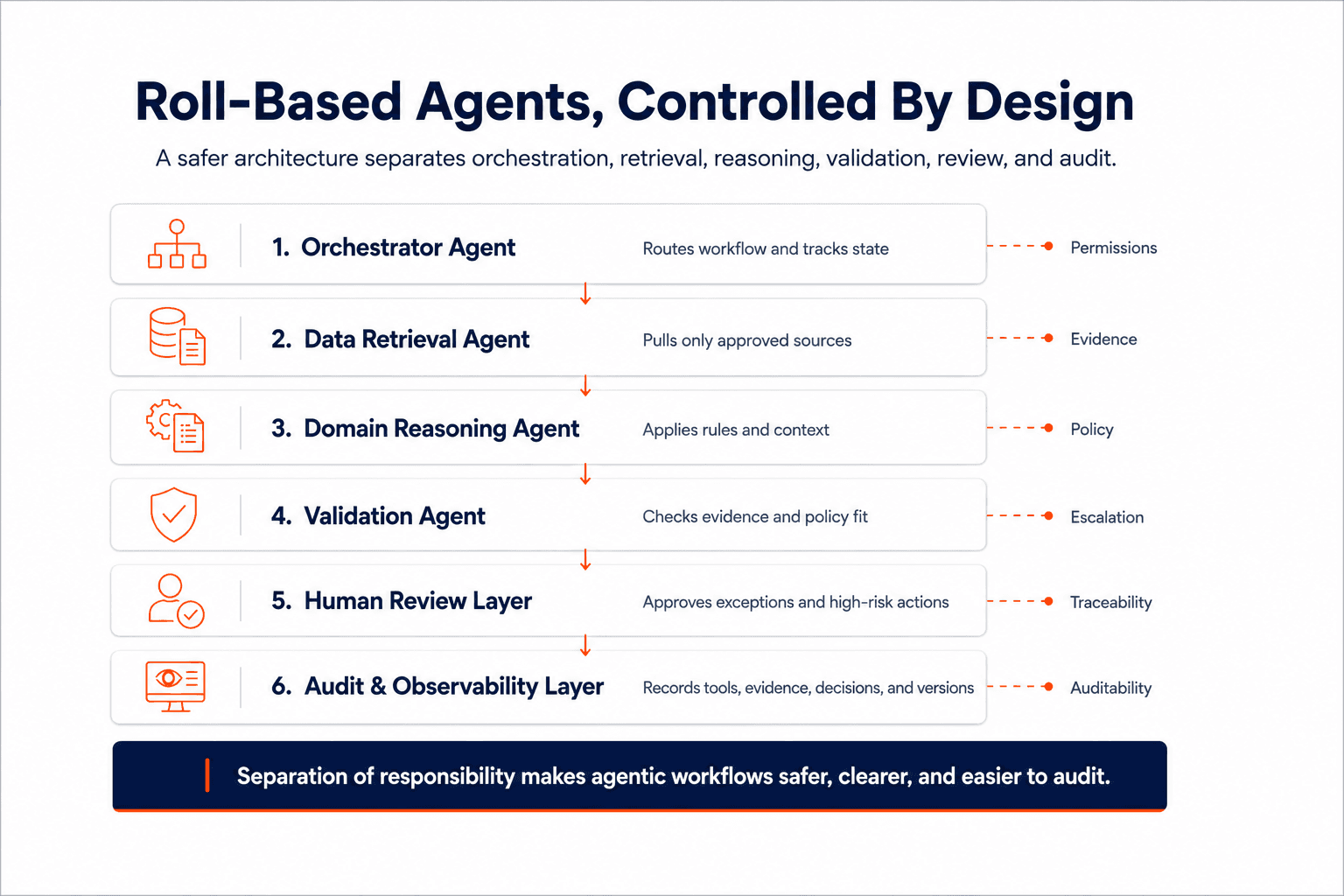
A simple pattern could look like this:
1. Orchestrator agent
Receives the user or system request, determines the workflow path, assigns tasks to specialist agents, and tracks the state.
2. Data retrieval agent
Fetches information only from approved systems, APIs, documents, and data stores.
3. Domain reasoning agent
Applies business logic, policies, rules, and contextual interpretation.
4. Validation agent
Checks whether the output is grounded, complete, policy-aligned, and safe to proceed.
5. Human review layer
Handles exceptions, low-confidence decisions, regulatory-sensitive outputs, and high-impact actions.
6. Audit and observability layer
Records the full execution path, tool usage, evidence, decisions, approvals, failures, and model versions.
The most important design principle is separation of responsibility.
An agent that retrieves data should not automatically approve a decision. An agent that recommends an action should not automatically execute it. An agent that summarizes a case should not be allowed to access every system unless the workflow requires it.
This is how multi-agent architecture becomes safer and more auditable.
Where AI Engineers Need to Make Tradeoffs
Multi-agent workflows are not automatically better than single-agent workflows. They are useful when the problem needs decomposition, specialization, validation, and control.
AI engineers need to make careful tradeoffs.
Single agent versus multi-agent
A single agent is simpler to build and operate. A multi-agent system is better when tasks require different roles, different tools, and independent validation.
Autonomy versus approval
More autonomy can reduce manual effort. More approval improves control. In finance, the right answer is often partial autonomy with human review for high-risk steps.
Reasoning versus rules
Agents are useful for interpretation and orchestration. Deterministic rules are better for policy checks, calculations, thresholds, and compliance gates.
Speed versus auditability
Less logging improves speed and cost. More tracing improves debugging, compliance, and trust.
Framework speed versus production readiness
Open-source frameworks help teams prototype quickly. But production requires authentication, security, monitoring, evaluation, deployment controls, and integration with enterprise systems.
These tradeoffs are also where intelligent automation solutions need a sharper engineering lens. The goal is not to automate every step. The goal is to decide which steps should be automated, which should be assisted, which should be validated, and which should remain under human control.
The Role of Frameworks Like AutoGen
Frameworks such as AutoGen help AI engineers explore multi-agent patterns, role-based collaboration, and orchestration flows.
But the framework is not the full solution.
In financial services, the production system also needs:
Enterprise authentication
Data access controls
Integration with core systems
Audit trails
Evaluation pipelines
Observability
Security testing
Deployment automation
Human approval workflows
Cost and latency governance
This is why the discussion should move from “Which framework should we use?” to “What architecture do we need around the framework?”
For AI engineers, the real skill is not only knowing how to connect agents. It is knowing how to design the system boundaries, failure paths, evaluation criteria, and operating model around them.
What This Means for Financial Services Leaders?
For financial services organizations, multi-agent AI should not start with a framework decision.
It should start with a workflow decision. Which business process is complex enough to benefit from agentic decomposition? Which parts can be automated safely? Which actions need human approval? Which data sources are trusted? Which tools can the agent use? How will outputs be evaluated? How will failures be traced? How will decisions be audited?
This is the difference between an impressive demo and a reliable production workflow. The strongest use cases are not always the most autonomous ones. They are often the ones where agents assist with research, triage, reconciliation, summarization, validation, and case preparation, while humans remain accountable for high-impact decisions. In financial services, that balance matters.
Why Financial Services Needs Multi-Agent Workflows
Financial services workflows are rarely single-step tasks.
A loan application, fraud investigation, reconciliation issue, wealth advisory request, claims review, or customer onboarding case usually moves across systems, documents, rules, approvals, and human decisions.
One system may hold customer data. Another may hold transaction history. Another may contain policy rules. Another may manage case notes, approvals, or audit trails.
A single AI agent can struggle when the workflow requires different skills at different points.
A multi-agent architecture allows the workflow to be broken into role-based agents. For example:
An intake agent can understand the request and classify the case.
A retrieval agent can gather relevant data from approved sources.
A reasoning agent can compare rules, documents, and transaction context.
A validation agent can check groundedness, missing evidence, and policy alignment.
A human-review agent can prepare the case for approval or escalation.
An audit agent can record what happened, which tools were used, and what evidence supported the final output.
This is where multi-agent systems become useful for financial services. They can mirror the way financial operations already work: distributed, role-based, controlled, and review-driven.
But this only works when the architecture is intentional.
The Demo-to-Production Gap
A demo usually proves that an agent can complete a happy-path task.
Production asks harder questions.
Can the agent handle incomplete data? Can it explain which source it used? Can it recover when a tool fails? Can we trace every step? Can we restrict what it is allowed to access? Can we measure whether it is getting better or worse over time? Can we stop it before it takes a high-risk action?
This is why an agentic workflow should not be treated like a chatbot feature. It behaves more like a distributed system with probabilistic reasoning inside it.
A production-ready multi-agent architecture needs five engineering layers:
Evaluation
Observability
Security
Deployment control
Silent failure handling
These are the areas where agentic systems usually break first. They are also where product engineering services need to go beyond prototype design and treat agent workflows as enterprise systems with measurable behavior, service boundaries, and operating controls.
1. Evaluation Gaps: The Demo Had Examples. Production Has Reality.
Most agent demos are tested on a small set of hand-picked examples.
That is not enough for financial services.
In production, the agent will see unclear customer requests, missing fields, duplicate records, contradictory documents, policy exceptions, edge cases, and workflows that do not match the original prompt design.
The first architecture pattern is to build an evaluation layer before scaling the workflow.
This means creating:
A golden dataset of real-world representative cases
Task success metrics for each agent role
Groundedness checks against approved evidence
Hallucination and unsupported-claim detection
Regression testing for prompts and tool usage
Multi-turn trajectory evaluation
Evaluation after deployment
LLM-as-judge scoring where appropriate
For a multi-agent workflow, final-answer accuracy is not enough. The system also needs process-level evaluation.
Did the intake agent classify the request correctly? Did the retrieval agent use the right source? Did the reasoning agent cite valid evidence? Did the validation agent catch missing context? Did the escalation logic trigger at the right time?
Reliable evaluation also depends on data engineering services that make approved sources discoverable, governed, and traceable. If the data layer is fragmented, stale, or poorly catalogued, the agent will inherit that weakness no matter how well the workflow is prompted.
This is especially important in finance, where a wrong answer is not just a poor user experience. It can become a compliance issue, customer-impact issue, or operational-risk event.
The practical engineering trade-off is speed versus confidence. Teams can move faster with flexible agents, but without an eval harness, they cannot reliably say whether each change improved or degraded the workflow.
2. Observability Blind Spots: Traditional Logs Are Not Enough
In a normal application, logs tell us what service was called, what error occurred, and where the request failed.
With agents, that is not enough.
The agent may succeed technically but fail logically. It may call the right tool with the wrong input. It may retrieve the right document and interpret it incorrectly. It may skip a validation step because the prompt changed. It may pass a weak intermediate answer to another agent, and the final output may still look polished.
This is why multi-agent workflows need agent-aware observability.
The observability layer should capture:
Agent trajectory logs
Tool-call traces
Prompt and response audit logs
Latency per step
Token usage per agent
Retrieval source IDs
Model version used
Decision checkpoints
Human review actions
Failure categories
For financial services, this matters because teams need more than debugging visibility. They need auditability.
If a lending agent recommends escalation, the business should know which evidence was retrieved, which rule was applied, what the intermediate path looked like at a system level, and where human review entered the workflow.
The trade-off is cost and complexity. Full tracing creates more telemetry, more storage, and more governance responsibility. But without it, teams are flying blind.
3. Security Holes: Agents That Can Act Can Also Be Misled
The risk profile changes when an AI system moves from answering questions to taking actions.
A multi-agent workflow may call APIs, retrieve sensitive data, update records, write files, trigger workflows, or interact with third-party tools. That makes it powerful, but also risky.
The security model needs to assume that agents can be manipulated.
Prompt injection is not only about a user typing a malicious instruction into a chat box. In agentic workflows, the attack can come through a retrieved document, tool description, third-party connector, web content, email, ticket, or internal knowledge source.
For financial services, this is serious because agents may interact with customer data, payment systems, account records, claims information, underwriting documents, or internal policy repositories.
A secure multi-agent architecture should include:
Least-privilege access for every agent
Separate permissions by role and workflow step
Tool-use sandboxing
Input and output filtering
PII detection and redaction
Human approval gates for high-risk actions
Policy checks before tool execution
Audit logs for tool calls and data access
Allowlisted tools and connectors
Continuous adversarial testing
For financial institutions, data security and compliance must be designed into agent permissions, tool access, approval gates, and audit trails. It cannot be added after the workflow has already been automated.
The tradeoff is autonomy versus control. The more freedom an agent has, the more useful it can become. But in finance, autonomy must be scoped. Some actions can be automated. Some actions should be recommended. Some actions must always require human approval.
That boundary has to be designed into the architecture.
4. Deployment Surprises: Shipping Agents Is Not Like Shipping Normal Features
A normal software release can usually be rolled back.
Agentic decisions are harder.
If an agent sends an incorrect response, updates a case, triggers a workflow, or influences a business decision, the impact may already exist before rollback happens. This makes deployment strategy more important.
Production agent workflows need controlled release patterns:
Shadow deployment
Canary rollout
Model versioning
Prompt versioning
Feature flags
Fallback model routing
Rate limiting
Cost governance
Latency budgets
Context window controls
Concurrency handling
Rollback and recovery paths
The cost profile also changes. A multi-agent workflow can trigger multiple model calls, retrieval steps, tool calls, and validation passes for one business request. In a demo, this looks manageable. At production volume, cost and latency can scale unpredictably.
This is where cloud enablement services and application modernization services become part of the agent architecture. Agents need stable APIs, scalable infrastructure, integration with legacy platforms, controlled deployment pipelines, and observability across the environments where financial workflows actually run.
For financial services, this creates an important engineering question: Which steps need agentic reasoning, and which steps should remain deterministic?
Not every part of the workflow needs an LLM. Some steps should be rule-based. Some should use retrieval. Some should use traditional APIs. Some should use human review.
A good architecture does not make everything agentic. It uses agents where reasoning, interpretation, and orchestration create clear value.
The tradeoff is intelligence versus predictability.
5. Silent Failure Handling: The Most Dangerous Failures Do Not Look Like Failures
The scariest agent failures are not crashes.
They are confident wrong actions.
The workflow completes. The answer looks clean. The system does not throw an exception. But the agent used weak evidence, missed a policy rule, misunderstood the customer request, or failed to escalate a risky case.
This is silent failure.
A production architecture should expect silent failures and design for containment.
This includes:
Circuit breaker patterns
Confidence thresholds
Hallucination checks
Evidence validation
Retry and idempotency controls
Error taxonomy
Human escalation paths
Graceful degradation
Post-decision sampling
Continuous monitoring of drift
The error taxonomy matters. Teams need to know whether a failure came from reasoning, retrieval, tool execution, data quality, permissions, latency, or infrastructure. Without that classification, every failure becomes a generic “agent issue.”
For financial services, silent failure handling should be part of the workflow design, not an afterthought.
Architecture Pattern: Role-Based Agents With Controlled Orchestration
A practical multi-agent architecture for financial services should start with role clarity.
Each agent should have a narrow responsibility, clear input boundaries, defined tool permissions, and measurable output expectations.
A simple pattern could look like this:
1. Orchestrator agent
Receives the user or system request, determines the workflow path, assigns tasks to specialist agents, and tracks the state.
2. Data retrieval agent
Fetches information only from approved systems, APIs, documents, and data stores.
3. Domain reasoning agent
Applies business logic, policies, rules, and contextual interpretation.
4. Validation agent
Checks whether the output is grounded, complete, policy-aligned, and safe to proceed.
5. Human review layer
Handles exceptions, low-confidence decisions, regulatory-sensitive outputs, and high-impact actions.
6. Audit and observability layer
Records the full execution path, tool usage, evidence, decisions, approvals, failures, and model versions.
The most important design principle is separation of responsibility.
An agent that retrieves data should not automatically approve a decision. An agent that recommends an action should not automatically execute it. An agent that summarizes a case should not be allowed to access every system unless the workflow requires it.
This is how multi-agent architecture becomes safer and more auditable.
Where AI Engineers Need to Make Tradeoffs
Multi-agent workflows are not automatically better than single-agent workflows. They are useful when the problem needs decomposition, specialization, validation, and control.
AI engineers need to make careful tradeoffs.
Single agent versus multi-agent
A single agent is simpler to build and operate. A multi-agent system is better when tasks require different roles, different tools, and independent validation.
Autonomy versus approval
More autonomy can reduce manual effort. More approval improves control. In finance, the right answer is often partial autonomy with human review for high-risk steps.
Reasoning versus rules
Agents are useful for interpretation and orchestration. Deterministic rules are better for policy checks, calculations, thresholds, and compliance gates.
Speed versus auditability
Less logging improves speed and cost. More tracing improves debugging, compliance, and trust.
Framework speed versus production readiness
Open-source frameworks help teams prototype quickly. But production requires authentication, security, monitoring, evaluation, deployment controls, and integration with enterprise systems.
These tradeoffs are also where intelligent automation solutions need a sharper engineering lens. The goal is not to automate every step. The goal is to decide which steps should be automated, which should be assisted, which should be validated, and which should remain under human control.
The Role of Frameworks Like AutoGen
Frameworks such as AutoGen help AI engineers explore multi-agent patterns, role-based collaboration, and orchestration flows.
But the framework is not the full solution.
In financial services, the production system also needs:
Enterprise authentication
Data access controls
Integration with core systems
Audit trails
Evaluation pipelines
Observability
Security testing
Deployment automation
Human approval workflows
Cost and latency governance
This is why the discussion should move from “Which framework should we use?” to “What architecture do we need around the framework?”
For AI engineers, the real skill is not only knowing how to connect agents. It is knowing how to design the system boundaries, failure paths, evaluation criteria, and operating model around them.
What This Means for Financial Services Leaders?
For financial services organizations, multi-agent AI should not start with a framework decision.
It should start with a workflow decision. Which business process is complex enough to benefit from agentic decomposition? Which parts can be automated safely? Which actions need human approval? Which data sources are trusted? Which tools can the agent use? How will outputs be evaluated? How will failures be traced? How will decisions be audited?
This is the difference between an impressive demo and a reliable production workflow. The strongest use cases are not always the most autonomous ones. They are often the ones where agents assist with research, triage, reconciliation, summarization, validation, and case preparation, while humans remain accountable for high-impact decisions. In financial services, that balance matters.

Fig: Production success starts where the framework ends.
Conclusion
Multi-agent AI has real potential in financial services, but only when it is engineered with the same seriousness as any other enterprise platform. The agent is only one part of the system.
The production architecture must handle evaluation, observability, security, deployment, auditability, and silent failure recovery. It must define what each agent can do, which tools it can access, when it should escalate, and how every decision can be traced.
The demo proves possibility.
Production proves architecture.
For AI engineers, this is where the real work begins.
Join our newsletter.
Smart reads, bold ideas and what’s next sent to you.
Resources
Join our newsletter.
Smart reads, bold ideas and what’s next sent to you.
Resources
Join our newsletter.
Smart reads, bold ideas and what’s next sent to you.
Resources